


It is ten o’clock at night. You are in a hotel in a country where you do not speak the language, and the bathroom has run out of toilet roll.
You know how to book a room. You can give your name at the desk and ask what time breakfast starts. But now you have to go downstairs and ask for toilet roll, and suddenly there are no words at all. Nobody enjoys talking about toilets in their own language, and it feels much worse in a second one. So you stand there and think about it. Can it wait until the morning?
This is the part of travel English that most courses miss.
Everybody practises the check-in conversation, and that is the conversation you need the least. The person at the desk does it fifty times a day. They ask for your passport. You give them your passport. Even with very little English, you will get your room. The airport is the same. The ticket machine is the same. These moments are easy because everybody already knows what is going to happen.
The difficult moments are different. The taxi does not arrive. There is no hot water. The train is cancelled, and you did not understand the announcement. You need something at ten o’clock at night, and you do not know the word for it.
You do not always need the word
When learners do not know a word, most of them stop and try to remember it. You do not have to do that. You can go around the word instead.
Describe what the thing does, or where it is, or what has happened:
“Sorry, I do not know the word in English. It is the paper you use in the bathroom.”
“It is a small plastic thing, about this big, for giving power to a phone.”
“There is a problem in room 214. There is no hot water.”
English speakers do this too. They forget words all the time and say “the thing you xxx”, and nobody thinks it is strange. You are allowed to do exactly the same. Saying “I do not know the word” is not a mistake. It is a normal part of a conversation, and it usually makes the other person want to help you.
If you want the word for next time, ask for it while you are there: “What do you call this?” Most people are happy to tell you.
Two questions do most of the work
You do not need fifty phrases. You need two or three that come out of your mouth automatically.
“Could I have some more towels, please?”
“Could you help me? I have a problem with the shower.”
“Would it be possible to leave my suitcase here until four o’clock?”
“I am looking for the station.”
“Could I have” and “could you help me” will get you through almost every hotel, shop, station, and pharmacy. Practise them until you do not have to think about them.
That last part matters more than it sounds. When something goes wrong, you feel stressed, and stress takes away your newest language first. Anything you have to build in your head in the moment will disappear. Anything automatic will stay.
Please and could are enough, by the way. Long polite forms are correct English, but they are a bad choice at a busy desk. “I was wondering whether it might be possible to...” takes four seconds to say and gives the other person more to understand. Short and polite works better than long and polite.
Asking is one sentence. The answer is ten
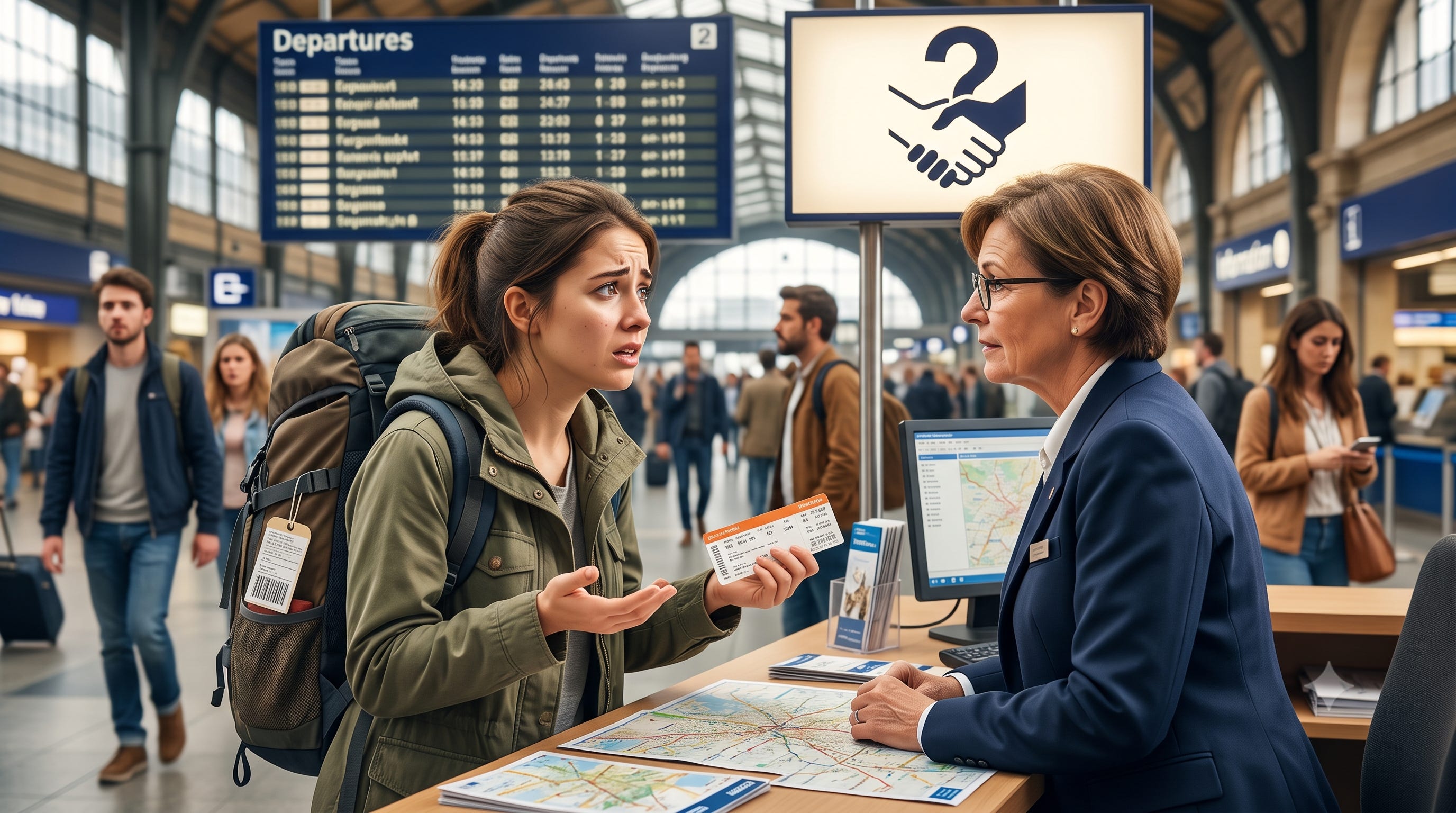
This is where most people really get stuck. Asking for directions is easy, and you can practise “excuse me, how do I get to the station?” until it is perfect. Then you get ten seconds of fast English back, with three street names you have never heard and a hand pointing behind you.
So practise these as seriously as you practise the questions:
“Sorry, could you say that again more slowly?”
“Sorry, is that left or right?”
“Could you show me on the map?”
And then use the one that almost nobody uses. Say the answer back in your own words.
“So, straight on, then left at the traffic lights, and it is next to the supermarket?”
Two things can happen. The person says yes, and you walk away sure. Or they correct the part you got wrong, which is exactly the part that would have made you lost. It takes five seconds, and it helps you more than another fifty words of vocabulary.
When something has gone wrong
A cancelled flight. The wrong room. A booking the hotel cannot find. Your suitcase is somewhere else. These conversations feel the hardest, and they all follow the same three steps.
Say what has happened.
Say what you need.
Ask what is possible.
“My connecting flight was cancelled. I need to get to Manchester tonight. What are my options?”
“I booked a double room and this is a twin. Could you check the booking, please?”
“The room next to us is very noisy and we cannot sleep. Could we move to another room?”
The best sentence there is the short one at the end of the first example. What are my options? Options are the different choices you have. That question gives the problem to the person who understands the system, and it usually gets you a short list to choose from instead of a long explanation you cannot follow. “What can I do?” and “What do you suggest?” do the same job.
One more thing about these conversations. The person in front of you almost never caused the problem. The airline cancelled the flight, not the woman at the desk. Staying calm is not only good manners. It is useful, because people do more for someone who is polite to them.
The real advice
Do not be afraid to ask.
People are usually nice. Most of them want to help you, and many of them are impressed that you are doing this in a second language at all. The thing that stops people asking is almost never their English. It is not wanting to look silly for ten seconds in front of a stranger they will never see again.
You can solve the toilet roll problem with pointing and an embarrassed smile. It works. It just takes two minutes, and the right sentence takes four seconds.
Come and join us. Your more confident English self is closer than you think.