


Phrasal verbs are often seen as one of the most challenging aspects of learning English. This is a common challenge, but with the right approach, they can become a natural and effortless part of your vocabulary.
This learning plan introduces an innovative, proven strategy. It will show you exactly how to use the ‘How To’ Guide and the Learning Notebook together, transforming a difficult task into a manageable, structured, and engaging process.
1. Understanding Your Tools: The Guide & The Notebook
These two books are designed to work together to create a powerful learning cycle. One book teaches you the core concepts and strategies, while the other provides the structure and space to put those concepts into practice.
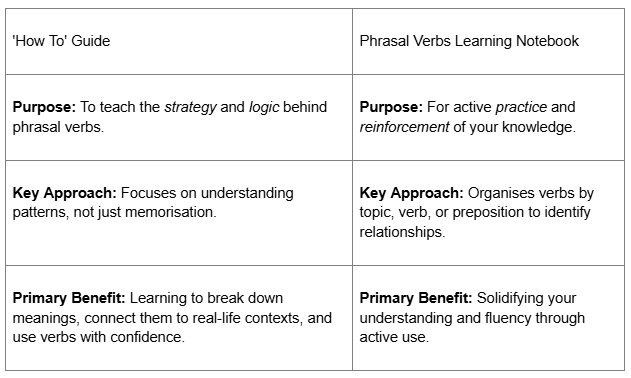
The Guide decodes the “why”—the hidden logic and patterns that govern phrasal verbs. The Notebook then provides the structured “how,” letting you see those very same patterns in action through its unique organisation, cementing the logic through targeted practice. Together, they create a complete cycle of learning and reinforcement.
Now that you understand your tools, let’s walk through the exact steps to use them effectively.
2. Your 4-Step Learning Cycle
This simple, repeatable cycle can be used for any new set of phrasal verbs you want to master.
Step 1: Understand the Logic (Using the ‘How To’ Guide) Start by choosing a concept, pattern, or group of phrasal verbs from the ‘How To’ Guide. The goal here is not to memorise a long, random list, but to understand the logic behind how these verbs are formed and what they mean.
Step 2: Group and Organise (Using the Learning Notebook) Next, open your Learning Notebook and find the phrasal verbs you just learned about. This is not a random list; the Notebook’s deliberate organisation by topic, verb, or preposition is designed to make the patterns you learned in the Guide immediately visible and concrete.
Step 3: Put Your Knowledge into Practice (Using the Notebook’s Practice Pages) Turn to the practice pages in the Notebook. This is the critical step that bridges understanding with application. Instead of just reading, apply your newfound skills by creating your own examples.
Create your own sentences.
Write short dialogues.
Build simple stories. By creating your own examples, you actively connect the verbs to real-life contexts, which is the key to true fluency.
Step 4: Review and Reinforce Regularly review the sentences, dialogues, and stories you created in your Notebook. This repetition is key to internalising the phrasal verbs and making them a natural, accessible part of your everyday English vocabulary.
By following this simple four-step cycle, you’ll transform phrasal verbs from a source of confusion into a tool for fluency.