


🔧Welcome to the Friday Fix!
👉 Each Friday, we break down a real-world professional problem and replace “textbook” phrases with the authentic, native-level language that actually gets results.
Elena has rehearsed her quarterly plan twice. Twelve slides, every number checked. She reaches the last slide, says “Any questions?”, and waits for a polite silence. Instead, the regional director, who has not spoken for forty minutes, unmutes his microphone: “Elena, if we moved the launch to January, what would that do to the cost?”
Nobody has asked her this. It is not on any slide. And on a video call, the small box with her face in it has become the biggest thing on everybody’s screen.
That is the thread of this week’s sprint. Monday’s post, Three seconds, showed that the silence feels much longer to you than to anyone else, and gave you phrases for buying time. Wednesday’s BizPod, Think on Your Feet, is about the same moment. Last week’s Fix was about a question you could see coming; this one comes from nowhere. So this week’s Fix is about what happens next: you have bought your two seconds, and now you need to say something in the next ten.
THE SITUATION
It is the end of the quarterly planning call. Elena has finished her presentation and is sharing her last slide. Henrik, the regional director, unmutes and asks:
“Thanks, Elena, that was clear. One question. If we moved the launch to January, what would that do to the cost?” - Henrik, the regional director
Elena knows the facts, but not in the order she needs them. Her answer comes out like this:
“Er... January? Um, so, I’m not sure. I think maybe it would be more expensive? Because, er, the warehouse... sorry, I didn’t prepare that. It depends. I can’t say now.”
Every word is honest, and none of it helps Henrik decide. He replies:
“OK. I’ll ask finance instead.” - Henrik
The call moves on. But Elena’s answer has now been handed to someone else.
THE CHALLENGE
Rewrite Elena’s answer so that it:
Does not fill the gap with “er” or “um”, and does not apologise
Checks what Henrik really wants to know before it answers
Gives one clear first view with a reason, not a guess at a number
Says what Elena will check, and by when
Starter phrases to reach for instead of “Er... um, so...”:
“That’s a fair question.”
“Are you asking about ... or ...?”
“My first view is ...”
“I’ll come back to you by ...”
THE FRAMEWORK: FEET
Monday gave you phrases for the first two seconds. What most people still lack is the order: what to say first, what to say next, and how to stop. FEET gives you four moves, in order, that you can build from nothing in about ten seconds.
Fill the gap. Say one short phrase instead of “er” - a phrase that tells the room you are thinking: “That’s a fair question.”
Establish the question. Check what they really want to know, with one clarifying question: “Are you asking about the extra cost, or the total cost?”
Express one point. Give your first view and one reason, in one sentence. Not the whole answer: “My first view is that January would add cost, mainly because of storage.”
Tie it off. Say what you will check and when you will answer, then stop: “I’d need to confirm the figure. I’ll come back to you by Thursday.”
If you used Monday’s tools, FEET sits on top of them. The buying-time phrases are the F, and the clarifying questions are the first E. The new parts are the second E and the T: a point you can make without knowing the number, and a promise with a deadline.
TOOLS TO HELP YOU

Toastmasters Table Topics - toastmasters.org
Toastmasters clubs have a regular exercise called Table Topics: one member is asked a question nobody has seen and answers it on the spot. The club finder on the site lets you look for online or in-person clubs, and a Toastmasters magazine article explains the exercise, saying a pause of ten to fifteen seconds to think is acceptable. The page does not state what membership costs, so check each club’s fees before you join.
Write Out Loud - Table Topics questions - write-out-loud.com
A page of more than 80 practice questions in four themes. Most are personal rather than work questions, which is useful here: choose one without looking, set a timer for 45 seconds and answer it out loud with FEET. Then turn it into a work question and answer again.
British Council LearnEnglish - learnenglish.britishcouncil.org
Free speaking and business English resources, including a Business English section with podcasts for professionals. Listen for how speakers begin an answer, then pause the recording and answer the same question yourself. The site may ask you to register for some resources.
Sometime before next Friday, someone will ask you something you did not see coming. It might be a manager in a corridor, a client on a call, or a friend who wants to know what you actually do all day. You will feel the old pull to fill the space with a sound. Notice that pull, and notice that you now have somewhere better to put it.
Try the challenge using FEET, then if you want the exact language, the model answer and full phrase breakdown, plus this week’s book recommendation are waiting below for paid members. You’ll also get a FEET AI prompt ready to use. Upgrade your subscription to read on.
Thanks for following English Language Lab! Please share this post.
Say It Better
If you’re a fan of communication frameworks, please take a moment to check out my book Say It Better. Available from your local Amazon store. More details below.
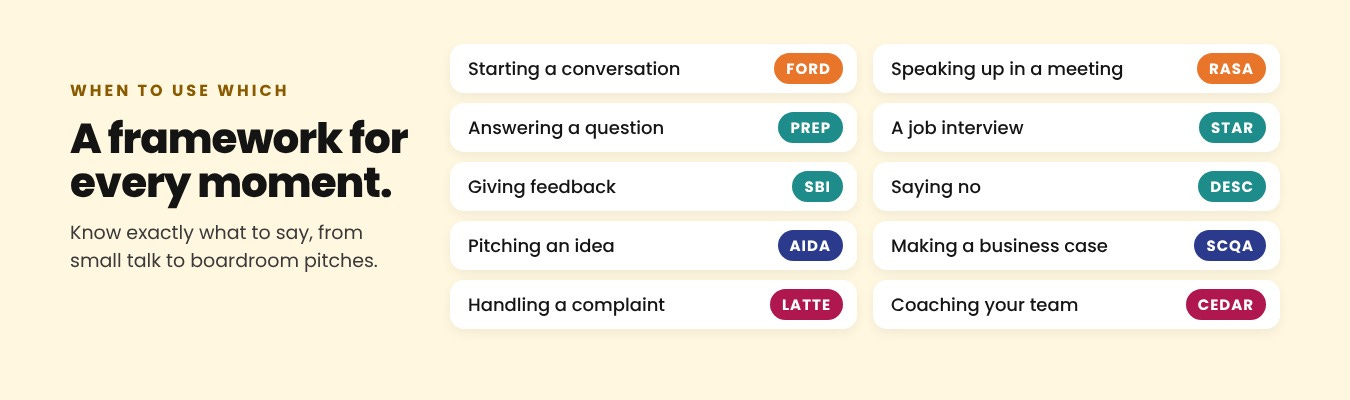
See inside the book and view more communication frameworks in the Say It Better Companion.