

🔧Welcome to the Friday Fix!
👉 Each Friday, we break down a real-world professional problem and replace “textbook” phrases with the authentic, native-level language that actually gets results.
You know something the whole call needs to hear. The decision is being made right now. And the person leading is talking so fast that every gap closes before you can use it.
That is where this week’s sprint has been heading. Monday’s lesson gave you the signal phrases for getting in, like “Could I add something here?”. Wednesday’s BizPod told you to speak early and to use PREP when you have the floor. This week’s Fix covers the moment between the two: the ten seconds when the decision is almost made and you have to get in, say one thing, and be heard.
THE SITUATION
It is Thursday morning, and eight people are on a Teams call. Priya, the project lead, is closing the plan: “So we are agreed, the launch is on the 12th, Marcus briefs the client tomorrow, great, next item.” You know the 12th is a problem, because the client’s sign-off panel meets that morning. You get your words out:
“Um, sorry, sorry, can I just say something? I don’t know if it’s important, but maybe the 12th could be a problem, I think. Sorry, I’m not sure...”
Count the softeners and fillers: um, sorry (three times), just, I don’t know if, maybe, could, I think, I’m not sure. That is ten in 28 words. Priya replies:
“Sorry, you’re breaking up a bit. Anyway - next item.” - Priya, Thursday morning
And that is the end of it. On Friday, Marcus briefs the client with the 12th. The client’s reply is polite and short: that is the morning of their board meeting.
THE CHALLENGE
Rewrite your break-in so that it:
Catches the speaker’s attention with a name, not with “sorry”
Puts the problem in the first sentence, before any background
Gives one reason, not three
Ends with a question, so the floor comes back to the group
Starter phrases to reach for instead of “Um, sorry, can I just say something?”:
“Before we lock that in -”
“One point on -”
“That clashes with -”
“Would ... work for you?”
THE FRAMEWORK: DOOR
A fast call does not leave a gap, so you do not wait for one. You open a door yourself, and you hold it open for ten seconds. Four steps:
Direct the signal. Start with the speaker’s name and a short request: “Priya, can I come in here?” A name gets attention faster than “sorry” does.
One-line point first. Give the headline before any background: “The 12th clashes with the client’s board meeting.”
One reason. Add a single reason, and stop: “Their sign-off panel sits that morning.”
Return the floor. End on a question that offers a way forward: “Would the 13th work for you?” Now the room has something to answer, not something to argue with.
TOOLS TO HELP YOU
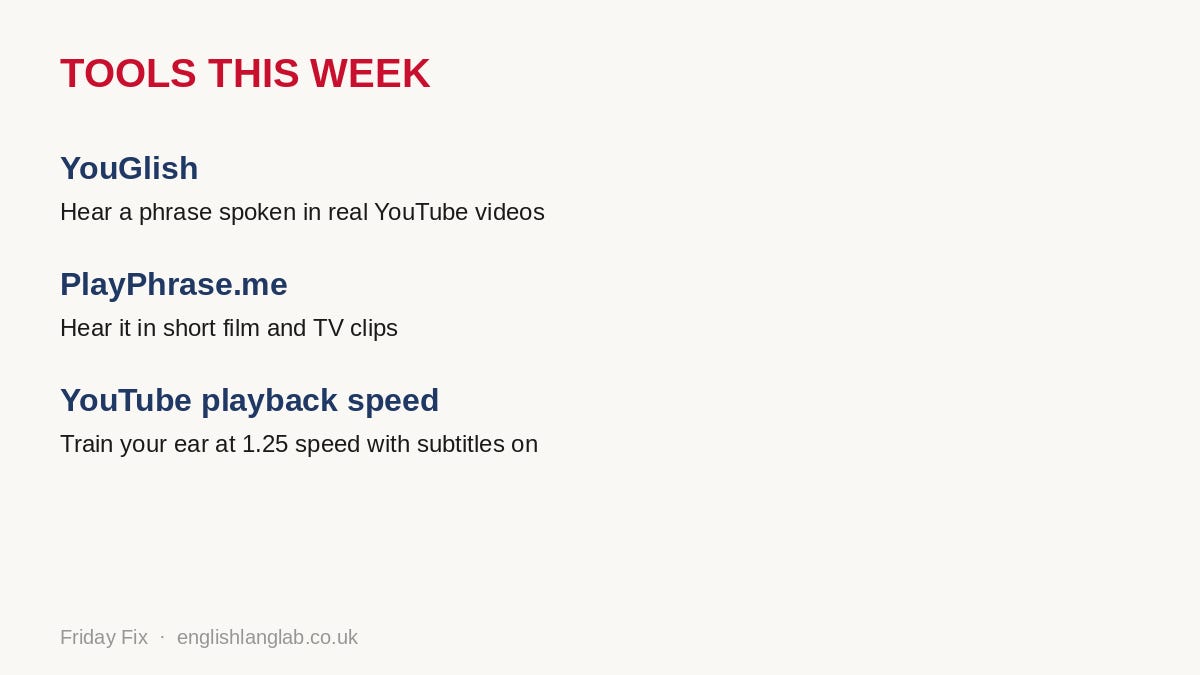
YouGlish - youglish.com
Type a phrase such as “before we lock that in” and hear it spoken in real YouTube videos, so you can hear the rhythm before you use it. Results include several English accents. The free plan has a daily search limit (reviews report 20 a day).
PlayPhrase.me - playphrase.me
Search a phrase and it plays short film and TV clips of people saying it. English only, and no sign-up is needed for the free version, which shows a handful of clips per search. Film dialogue is scripted, so use it for the sound of the phrase, not as a model of real meeting tone.
YouTube playback speed - youtube.com
Free and built in. Pick a panel discussion or a podcast with several speakers, set the speed to 1.25, switch on subtitles, and say your break-in out loud every time a speaker takes a breath. It trains your ear for the moment to go.
Try the challenge using DOOR, then if you want the exact language, the model answer and full phrase breakdown, plus this week’s book recommendation are waiting below for paid members. You’ll also get a DOOT AI prompt ready to use. Upgrade your subscription to read on.
Thanks for following English Language Lab! Please share this post.