

🔧Welcome to the Friday Fix!
👉 Each Friday, we break down a real-world professional problem and replace “textbook” phrases with the authentic, native-level language that actually gets results.
Tomas has finished a budget update on a video call. About nine people are watching. He has checked every figure, and he feels good about it. Then Margaret, the finance director, unmutes her microphone: “Tomas, these numbers don’t add up. Did anyone actually check them?”
Tomas did check them. But one line is an estimate, because the supplier’s final invoice has not arrived yet. His face feels hot, the call goes quiet, and the small box with his face in it is suddenly the biggest thing on everybody’s screen.
That is the thread of this week’s sprint. Monday’s lesson showed what to do when you owe someone an apology or an explanation: acknowledge, apologise once, explain, and offer a next step. This week’s Fix is the harder cousin. What do you say when the challenge is only partly fair? If you apologise for everything, you cave. If you defend everything, you attack. Wednesday’s BizPod, Listening Under Pressure, looks at the same moment from the listening side. This Fix is about the answer you give next.
THE SITUATION
It is the end of a budget update call. Tomas is sharing his last slide. Margaret, the finance director, speaks:
“Tomas, these numbers don’t add up. Did anyone actually check them?” - Margaret, the finance director
Tomas wants to protect his work, and the words come out fast:
“Yes! Of course we checked them. I checked them myself, twice. It’s not my fault if the finance system shows something different. I sent everything last week and nobody said there was a problem.”
Every sentence in it is understandable, and almost none of it helps. It says “it’s not my fault” before anyone has talked about fault, it suggests that the finance team did not read his email, and it never mentions the one true thing: that one line is an estimate. Margaret replies:
“I’m not interested in whose fault it is. Let’s take this offline.” - Margaret
The call moves on. But what the room remembers is a defensive answer, not the fact that Tomas checked.
THE CHALLENGE
Rewrite Tomas’s answer so that it:
Shows he has heard the concern before he defends anything
Owns the one part that is true, and only that part, with no blame and no excuses
Gives one or two facts, calmly, with the source
Offers to go through it after the call, with a time
Starter phrases to reach for instead of “Yes! Of course we checked them!”:
“I understand why it looks that way.”
“What’s true is ...”
“The figures come from ...”
“I’m happy to go through it ...”
THE FRAMEWORK: HOLD
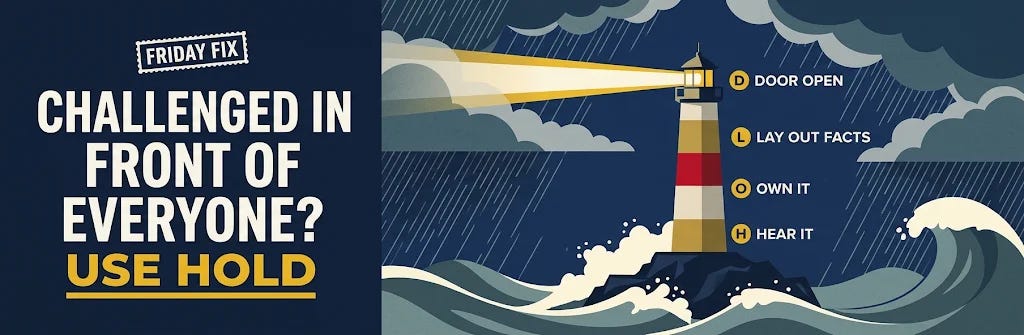
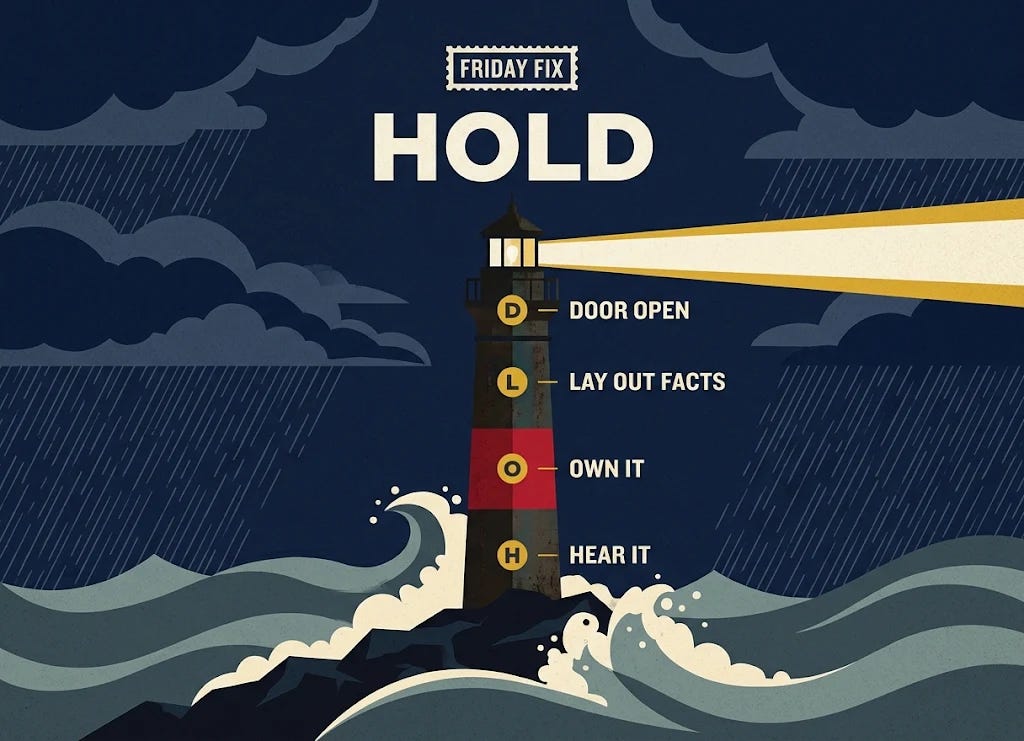
HOLD is for the challenge where you need to stay steady: not giving in, and not hitting back. It gives you four moves, in order, that you can build in about ten seconds.
Hear it. Acknowledge the concern before you say anything else. You do not have to agree with it - you only have to show you heard it: “I understand why it looks that way.”
Own what’s yours. Say the true part, and only the true part: “What’s true is that one line is an estimate, and I should have marked it more clearly.”
Lay out the facts. One or two facts, calmly, with the source, so that the facts do the arguing: “The figures come from the March invoices, and I’ve checked them twice.”
Door open. Offer to go through it later, with a time: “I’m happy to go through it with you after this call. I’ll send the invoices over at two.”
Notice the order. Most people start with the facts, and that sounds like a fight. In HOLD the small admission comes second and the facts come third, after the other person has felt heard.
TOOLS TO HELP YOU

Yoodli - yoodli.ai
An AI speech coach with roleplay practice, free to start. Choose a difficult-conversation scenario, answer out loud, and read the feedback on how you spoke. It is a low-risk place to practise being challenged. Check the site for the current free limits and which languages it supports.
Vocaroo - vocaroo.com
A free voice recorder that works in your browser, with no account needed. Record your HOLD answer, play it back, and listen to the last word of each sentence. Does your voice drop, or does it rise as if you were asking permission? Delete it and record again until it sounds level. This is also the tool for this week’s task.
YouGlish - youglish.com
Type a phrase such as “I understand why” and hear it in real videos, spoken by real people at normal speed. There is an option to choose a UK accent. Listen to three or four examples and notice how calm the speakers sound. Check the site for what is free and what needs an account.
Back on the call, Tomas has not said anything yet. Margaret is still waiting, and so are the nine faces. Nothing about the numbers has changed in these few seconds; only the order of what he says next. Before next Friday, try one small thing: say “The figures come from...” aloud, once, with any source you like - an invoice, a report, last week’s email. Listen to what your voice does on the last word. It should fall, and your shoulders usually follow.
Try the challenge using HOLD, then if you want the exact language, the model answer and full phrase breakdown, plus this week’s book recommendation are waiting below for paid members. You’ll also get a HOLD AI prompt ready to use. Upgrade your subscription to read on.
Thanks for following English Language Lab! Please share this post.
Say It Better
If you’re a fan of communication frameworks, please take a moment to check out my book Say It Better. Available from your local Amazon store. More details below.
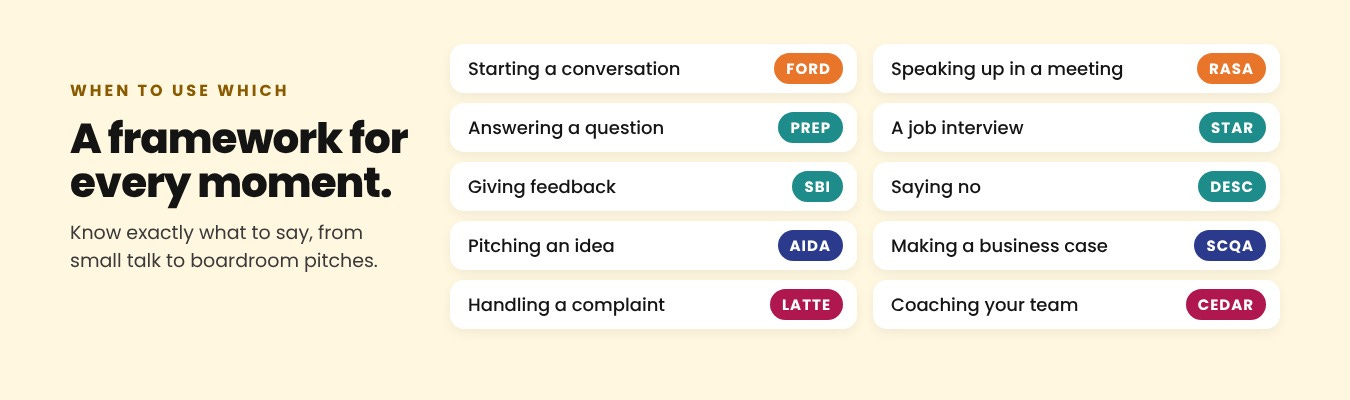
See inside the book and view more communication frameworks in the Say It Better Companion.