

🔧Welcome to the Friday Fix!
👉 Each Friday, we break down a real-world professional problem and replace “textbook” phrases with the authentic, native-level language that actually gets results.
You spot a real problem at work, you do the responsible thing and tell your manager, and nothing happens. Not because your manager doesn’t care. Because the way you said it made the problem sound small.
That is the question this week’s sprint has been building towards. Monday’s lesson showed you how to spot your hedges and swap them for confident phrasing. Wednesday’s BizPod gave you the certainty patterns, like “I’m convinced that”, and the idea that confidence comes from knowing your message. This week’s Fix puts both to work in the place where it matters most: a message about a problem.
THE SITUATION
It is Thursday afternoon. You have heard that an important supplier is going to deliver late, and the launch depends on it. You message your manager on Teams:
“Hi Dan, sorry to bother you, I just wanted to maybe mention that the supplier might possibly be a bit late with the delivery, but I’m not really sure, so it could be fine. Sorry!”
Count the softeners: sorry (twice), just, maybe, might, possibly, a bit, not really sure, could. That is nine in 35 words. Your manager replies:
“Thanks for the heads-up!” - Your manager, Thursday afternoon
And that is the end of it. On Friday morning the delivery is two days late and the client is on the phone.
THE CHALLENGE
Rewrite your message so that it:
States what you know as a fact, not a possibility
Names the one thing you don’t know, instead of a cloud of maybes
Tells your manager what you recommend they do next
Ends clearly, with no apology and no trailing “...if that’s OK”
Starter phrases to reach for instead of “Sorry, I just wanted to maybe mention...”:
“I can confirm that -”
“What I don’t know yet is -”
“I’d recommend we -”
“I’ll have an update by -”
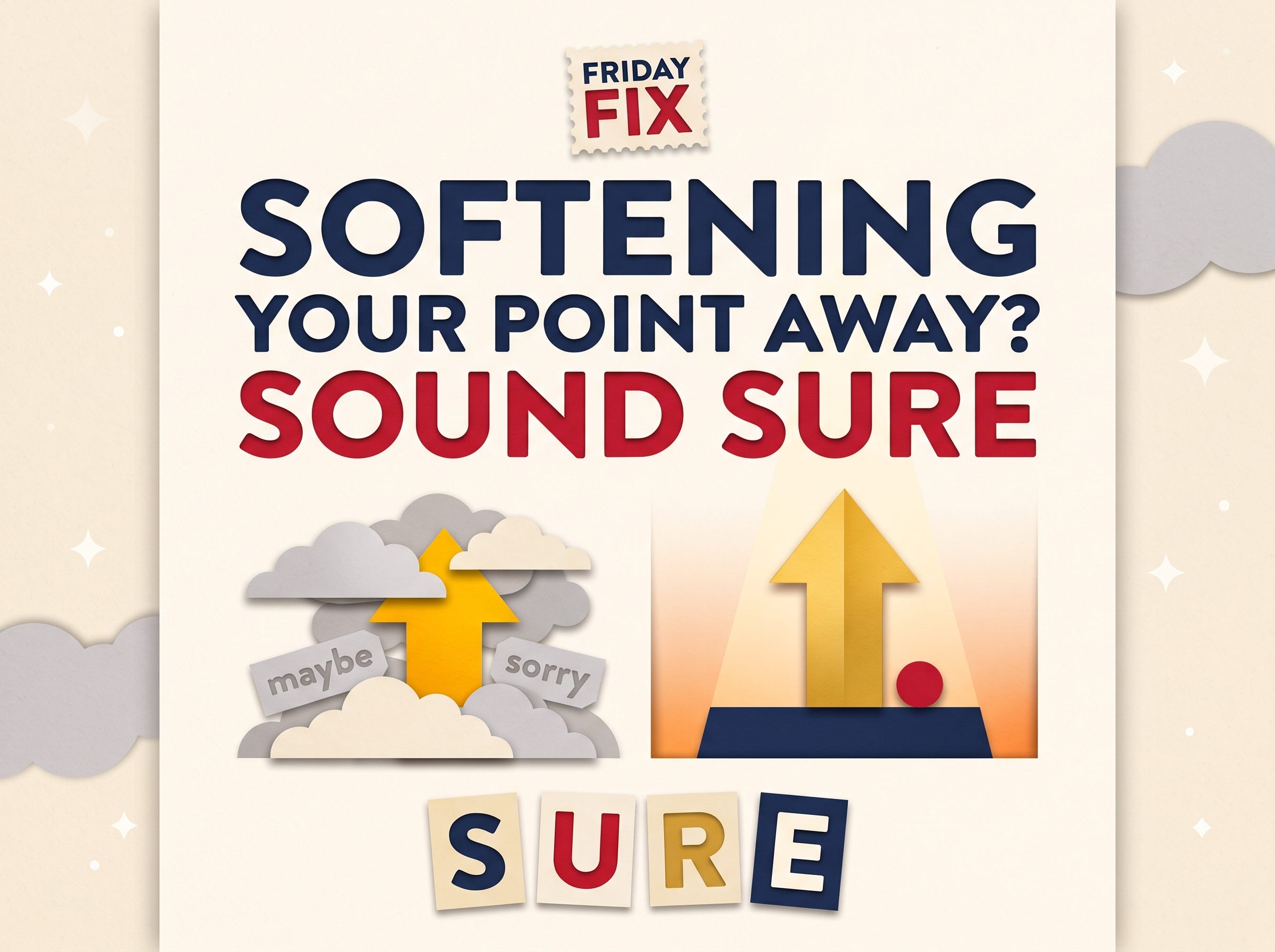
THE FRAMEWORK: SURE
Sound SURE without being sure of everything. When you need to share a risk, follow this four-step shape:
Say what you know. State the confirmed fact as a fact, with “will” or “is”: “The supplier’s delivery will be late.”
Underline the one unknown. Name the single thing you don’t know yet, precisely: “What I don’t know yet is whether they can ship in parts.”
Recommend a next step. Say what you would do: “I’d recommend we warn the client today.”
End firmly. Finish with an action and a full stop. No “sorry!” and no trailing “...if that’s OK”.
TOOLS TO HELP YOU
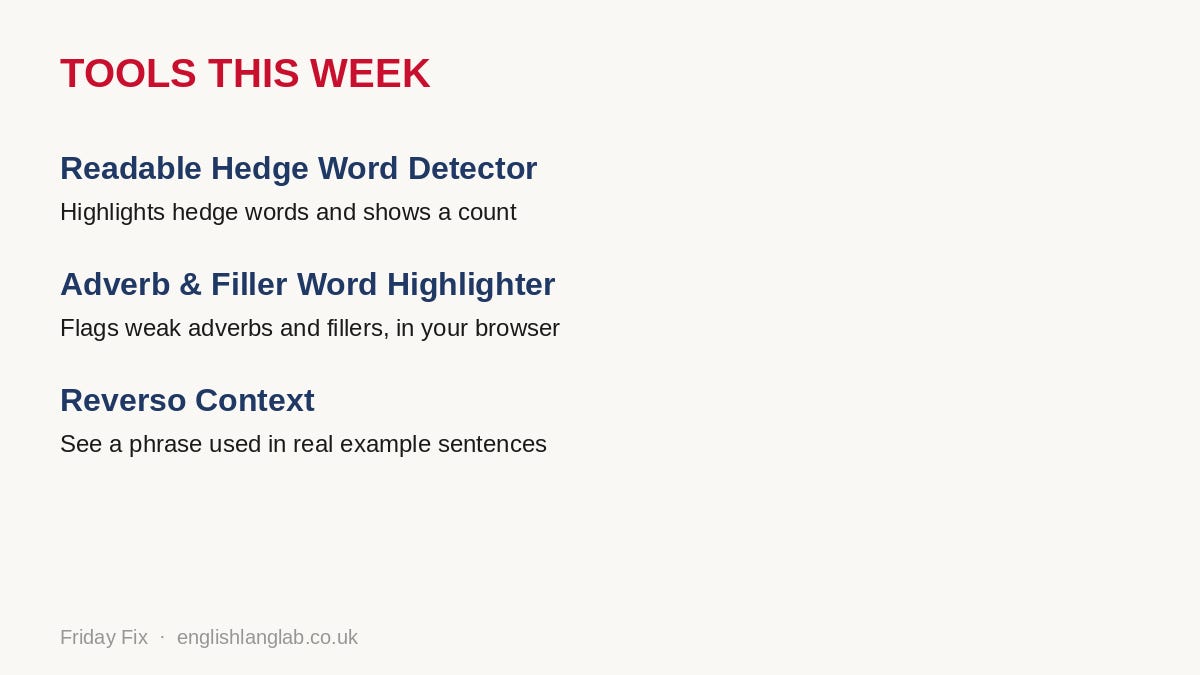
Readable Hedge Word Detector - app.readable.com/text/hedge
Paste in a draft message and it highlights words that are commonly hedges, with a count. Not every highlighted word is a hedge, so use it as a prompt to check your draft, not as a verdict. Free use is limited.
Adverb & Filler Word Highlighter - adverb-filler.utils.com
Highlights weak adverbs, filler words like “just”, and hedging language, with a density score. The site says the analysis runs in your browser, which is useful when your message is about a real work problem.
Reverso Context - context.reverso.net
Type a phrase such as “I’d recommend we” and see it used in real example sentences, so you can check that a pattern sounds natural before you send it.
Try the challenge using SURE, then if you want the exact language, the model answer and full phrase breakdown, plus this week’s book recommendation are waiting below for paid members. You’ll also get a SURE AI prompt ready to use. Upgrade your subscription to read on.
Thanks for following English Language Lab! Please share this post.