

🔧Welcome to the Friday Fix!
👉 Each Friday, we break down a real-world professional problem and replace “textbook” phrases with the authentic, native-level language that actually gets results.
You have prepared for the hard questions. The weakness question, the salary question, the “why us?” question. The video interview starts at ten o’clock, and Daniel, the hiring manager, smiles, says hello and asks the easy one: “So, tell me a little about yourself.”
For about two seconds, nothing happens. Then your mouth starts without your brain.
That is the thread of this week’s sprint. Monday’s lesson gave you the shape of a good answer (now, before, next) and the tense choice inside it. Wednesday’s BizPod explained why a framework works as a safety net for your brain. This week’s Fix is about the part neither of them can do for you: the first ten seconds, when you know the shape but your mind is empty.
THE SITUATION
It is a video interview for a project coordinator role. Daniel has said hello. You have your notes in front of you, and still your answer comes out like this:
“Um, so... well, I’m working in logistics now, I think. Before that I was in customer service, and, er, before that I studied languages, and... sorry. I like working in a team. I’m a hard worker. Yes. That’s... yes. I don’t know what else.”
Every sentence is true, and none of it is a headline. Daniel is friendly, and he replies:
“Great, thanks. And what made you apply for this role?” - Daniel, ten o’clock
The interview goes on. But when it ends, Daniel writes one line in his notes: “Nice person. Not sure what they actually do.”
THE CHALLENGE
Rewrite your answer so that it:
Starts with one sentence that says who you are at work, not with “um” or with your life story
Gives one specific proof, not your whole CV
Says where you want to go next, and why this role fits
Ends clearly, in about a minute, instead of trailing off
Starter phrases to reach for instead of “Um, so, well...”:
“I’m a ... who ...”
“Last year I ...”
“Now I’d like to ...”
“I’d be happy to say more about ...”
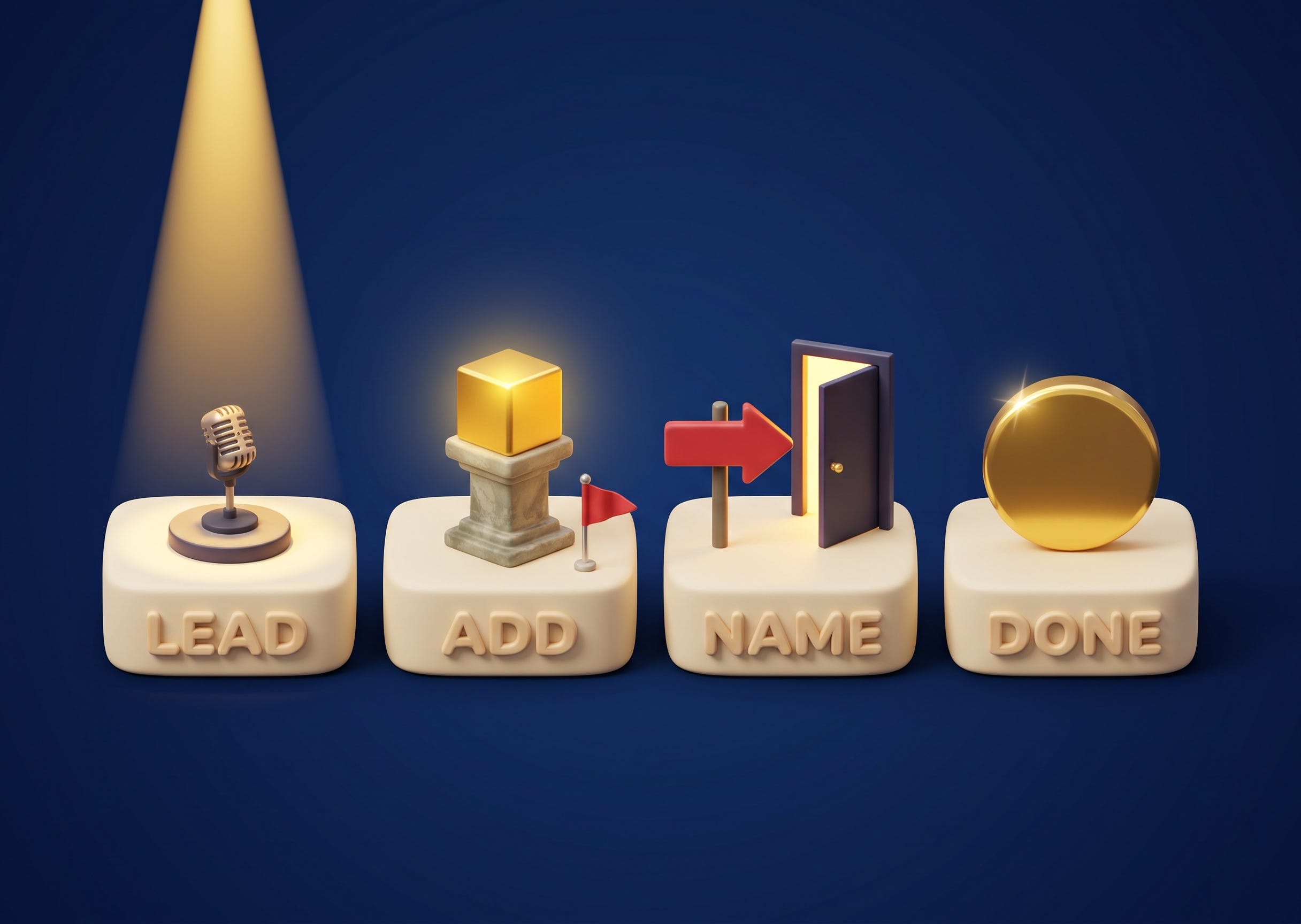
THE FRAMEWORK: LAND
The freeze happens in the first ten seconds. You do not know how to start, and you do not know how to stop. LAND solves both: a first sentence that needs no thinking, and a last sentence that tells everyone you have finished. Four steps:
Lead with a headline. One sentence with your role and what you are good at: “I’m a project coordinator who gets late projects back on track.”
Add one proof. One specific result, in past simple: “Last year I took over a delivery project that was three weeks behind, and we delivered on time.”
Name what’s next. Say where you want to go, and why this role fits: “Now I’d like a role with more responsibility for planning.”
Done. Say one closing sentence, then stop and let the silence be Daniel’s turn: “I’d be happy to say more about any of that.”
TOOLS TO HELP YOU

Yoodli - yoodli.ai
An AI speaking coach. Choose an interview practice session, answer out loud and get feedback on how you came across. The free Starter plan gives you five practice sessions in total (a session counts once it runs past 30 seconds), and you need to sign up. The site does not say how well it handles different accents, so treat the feedback as a guide, not a verdict.
Your phone’s voice recorder - built into your phone
Free and already there. Record your LAND answer twice and listen back. Check three things: does your first sentence start within two seconds, does your voice drop at the end, and does the whole answer take about a minute?
Cambridge Dictionary - dictionary.cambridge.org
Use it to choose the verb for your proof. Look up “run”, “lead” or “launch” and read the example sentences to see which one fits your job. Each entry shows the pronunciation, so you can check it before you say it out loud.
Back in that video interview, Daniel’s question has not changed, but the first four seconds could. The next time someone asks you to introduce yourself, whether in a meeting, at a networking event or in the first minute of a client call, notice what you say first. If it is “um”, or the year you graduated, that is your cue. You already know what to put there instead.
Try the challenge using LAND, then if you want the exact language, the model answer and full phrase breakdown, plus this week’s book recommendation are waiting below for paid members. You’ll also get a LAND AI prompt ready to use. Upgrade your subscription to read on.
Thanks for following English Language Lab! Please share this post.
Say It Better
If you’re a fan of communication frameworks, please take a moment to check out my book Say It Better. Available from your local Amazon store. More details below.
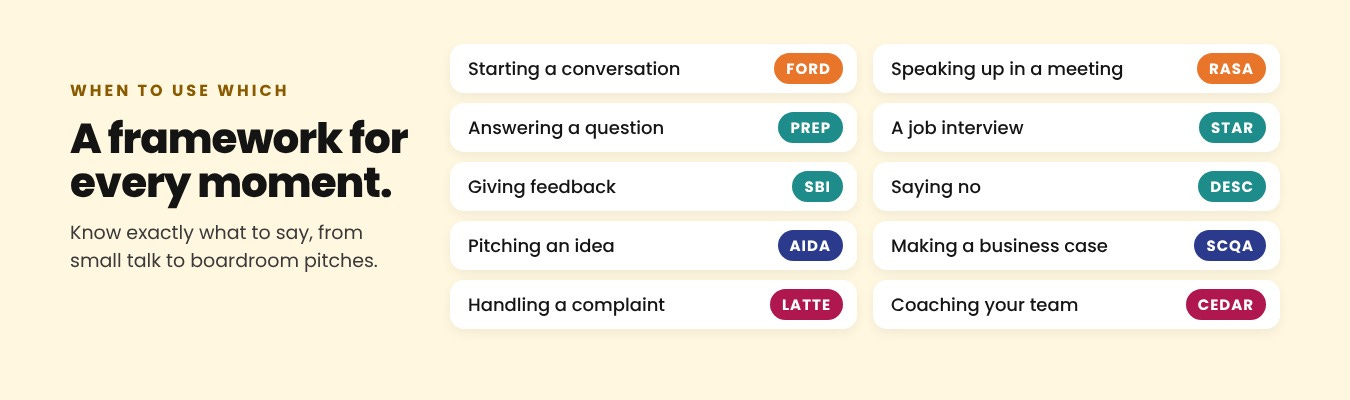
See inside the book and view more communication frameworks in the Say It Better Companion.
Say It Better at Work
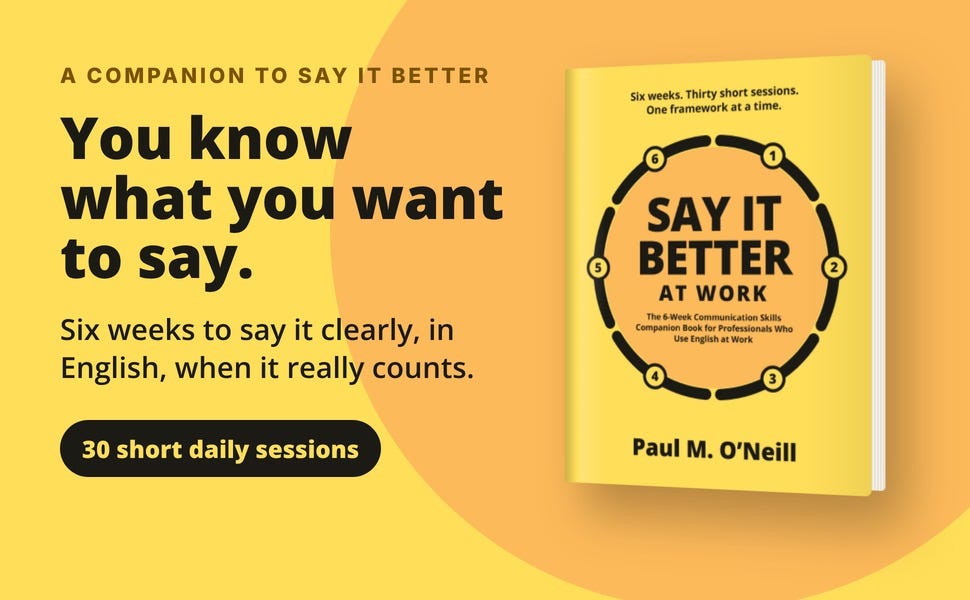
The new companion workbook that guides you through real work situations and helps you decide which frameworks works best for you.
Say It Better at Work is available NOW from your local Amazon store.
Find out more on the SIB at Work Companion site.