


🔧Welcome to the Friday Fix!
👉 Each Friday, we break down a real-world professional problem and replace “textbook” phrases with the authentic, native-level language that actually gets results.
You read it back before you hit send. Every sentence is correct. The grammar is clean, the spelling is right, and there is nothing a teacher could circle in red pen. And yet something about it feels wrong - stiff, distant, like it came out of a template rather than out of you.
That is exactly the problem this month’s sprint is built to fix. Monday’s lesson made the case for keeping your fillers and softeners instead of cutting them, and for leaning on contractions, stress and connectors to sound like a person rather than a rulebook. This week we take that same idea and move it from your mouth to your keyboard - because a stiff email does the same damage as a stiff sentence on a call, just slower and in writing, where the other person has time to reread it and decide what you “really” meant.
THE SITUATION
“Hi - just checking in. Any update on the Henderson deck? I need to know if it’s still on track for Friday’s client call.” - Message from a colleague, 11:40am
It is Wednesday. The deck is not quite on track - you are a day behind because the numbers came in late from finance - but it will absolutely be ready by Friday morning. You open a reply.
THE CHALLENGE
Your reply needs to:
Tell the truth about where things stand, without sounding like you are making excuses
Reassure your colleague the deadline is still safe
Sound like you, not like an automated status update
Starter phrases to reach for instead of the textbook version:
“Quick update -”
“Slight snag, but nothing that affects Friday -”
“Should still be fine for -”
THE FRAMEWORK: WARM
Write it, then read it back the way you would say it out loud. If it sounds like a letter from a bank, it needs work.
Add a softener. Drop in one small connector - just, to be honest, I think - to take the edge off a flat statement.
Restore your contractions. “I will” becomes “I’ll”. “It is” becomes “it’s”. Full forms read as formal at best, cold at worst.
Mind the stakes. Natural is not the same as careless. Keep the message clear and respectful - warm it up, do not water it down.
Try the challenge using WARM, then if you want the exact language, the model answer is waiting below for paid members.
TOOLS TO HELP YOU
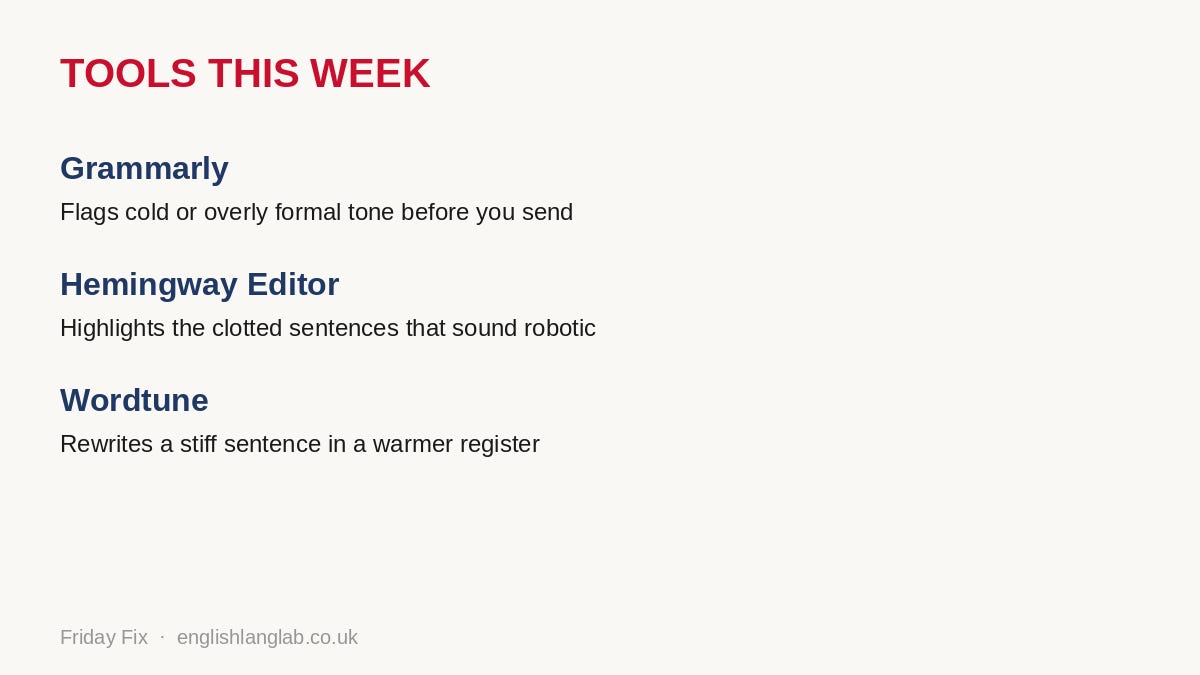
Grammarly - grammarly.com
Its tone detector flags when a draft reads as cold, demanding or overly formal before you send it - useful for catching the robotic version you did not notice.
Hemingway Editor - hemingwayapp.com
Highlights long, clotted sentences and passive constructions, the two things that make written English sound like a policy document instead of a person.
Wordtune - wordtune.com
Offers several rewrites of the same sentence in different registers, so you can see your stiff first draft sitting right next to a warmer, more natural version.
Try the challenge using WARM, then if you want the exact language, the model answer and full phrase breakdown, plus this week’s book recommendation are waiting below for paid members. You’ll also get a WARM AI prompt ready to use. Upgrade your subscription to read on.
Thanks for following English Language Lab! Please share this post.