

🔧Welcome to the Friday Fix!
👉 Each Friday, we break down a real-world professional problem and replace “textbook” phrases with the authentic, native-level language that actually gets results.
You have a good idea. You have thought about it, your English is clear, and you say it in the team meeting. Nobody reacts. Someone says “Thanks, noted” and the conversation moves on.
Ten minutes later, a colleague says almost the same thing, and people nod. Same idea. Different reception. The difference was not the grammar. It was the shape.
That is the question this week’s sprint has been building towards. Monday’s lesson gave you three moves for making your English compelling, not only correct: stress, contrast and the cleft sentence. Wednesday’s BizPod showed how to structure a point so it is easy to follow. This week’s Fix puts them to work in one live moment, the first ten seconds of an idea in a meeting.
THE SITUATION
It is Thursday, 10:15, in the team meeting. Clients keep telling your manager that the monthly report is too long to read. You have a fix, so you speak up:
“Sorry, this might be a silly idea, but maybe we could possibly think about perhaps making the client report a bit shorter?”
Silence. Your manager says, “Thanks, noted,” and moves on to the next item. Ten minutes later, a colleague says:
“What our clients need is a shorter report. Not more data - a clearer answer.” - Colleague, ten minutes later
Heads nod. Your manager writes it down and says, “Good point. Let’s do that.”
THE CHALLENGE
Rewrite your opening sentence so that it:
Starts with the point, not with an apology
Puts the stress on the one word you want people to remember
Shows what the point is not, so that what it is stands out
Uses a cleft sentence to point the room at the key idea
Starter phrases to reach for instead of “Sorry, this might be silly, but...”:
“What our clients need is -”
“It was the ... that ...”
“The main point is -”
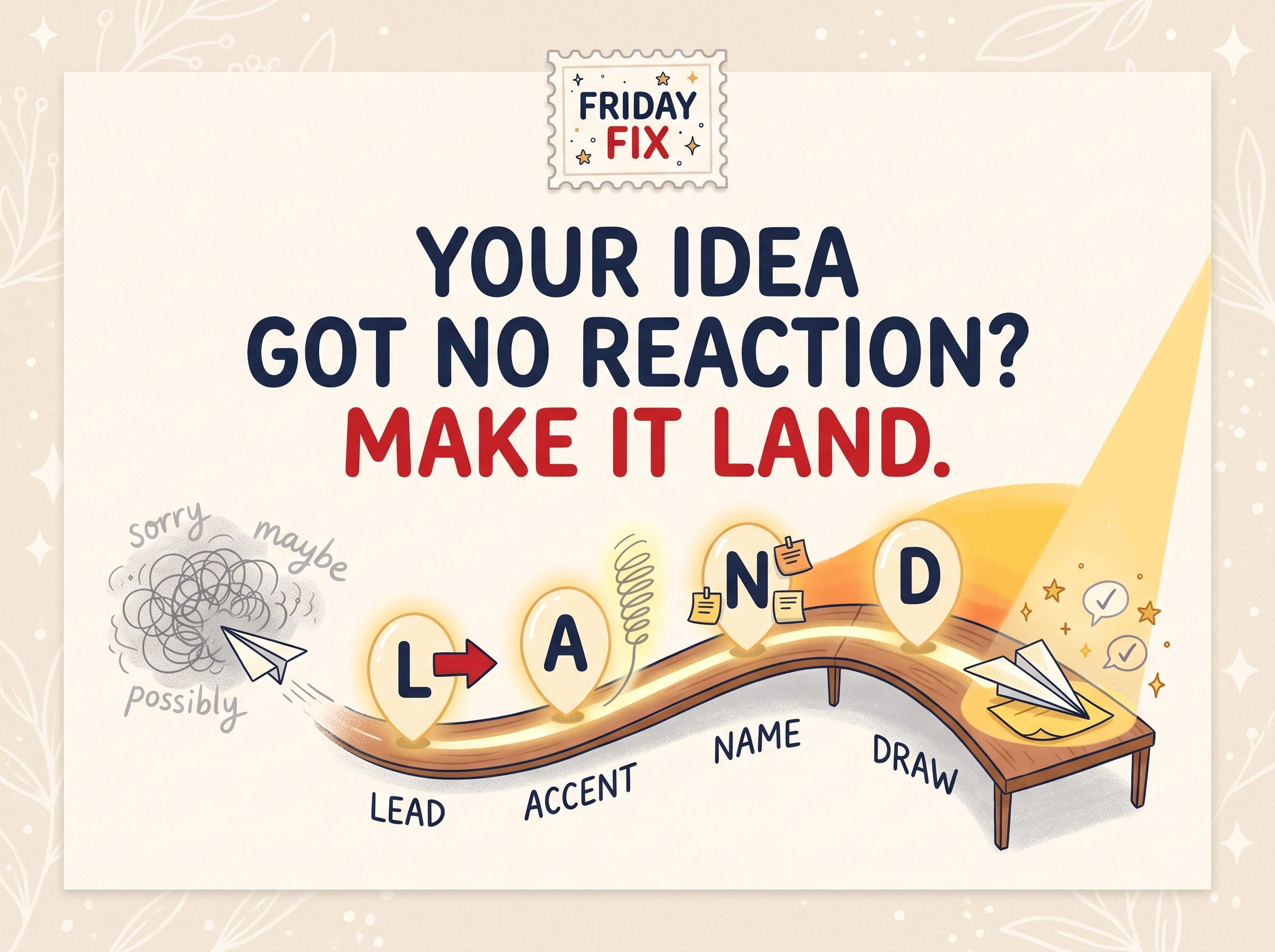
THE FRAMEWORK: LAND
Land the idea, not the apology. When you want a point to be heard, follow this four-step shape:
Lead with the point. Open with the idea itself, not with “sorry” or “this might be silly”. The first words decide whether the room leans in.
Accent the key word. Push the stress on the one word you want remembered: “a SHORTER report”. Everything else stays light.
Name what it isn’t. Show the contrast: “not more data, a clearer answer”. Saying what the point is not makes it stand out.
Draw the spotlight. Use a cleft sentence to point at the key idea: “What our clients need is...” or “It’s the length that...”.
TOOLS TO HELP YOU
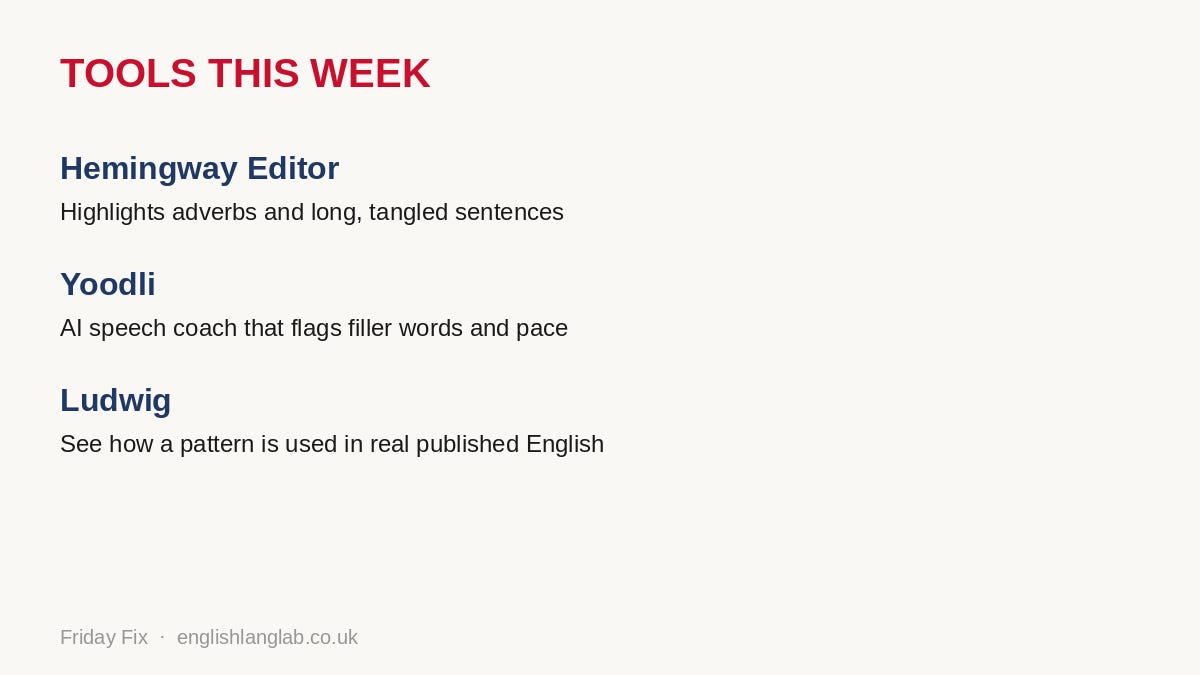
Hemingway Editor - Paste in the sentence you plan to say. It highlights adverbs and long, tangled sentences, which is exactly where “maybe, possibly, a bit” hide.
Yoodli - An AI speech coach. Record yourself giving your point and it flags filler words and pace, so you can hear whether your opening is clear or buried.
Ludwig - A sentence search tool. Type a pattern such as “What we need is” and see how it is used in real published English before you use it yourself.
Try the challenge using LAND, then if you want the exact language, the model answer and full phrase breakdown, plus this week’s book recommendation are waiting below for paid members. You’ll also get a LAND AI prompt ready to use. Upgrade your subscription to read on.
Thanks for following English Language Lab! Please share this post.