


A meeting ends well. As you’re leaving, the other person says, “We should grab a coffee sometime.” You smile and agree. Then you get back to your desk, and you’re not sure what just happened.
Was that a plan? Should you email them?
If you do, will you look too keen? If you don’t, will you look rude?
Your English is fine. That’s not the problem. The problem is that this phrase is doing a job no coursebook explains.
In English, and especially in British working life, a lot of invitations come wrapped in food and drink. A coffee. Lunch. A quick drink after work. But here’s the part that catches people out: not all of them are plans.
Some are real, and some are simply a warm way of saying goodbye.
Both are completely normal, and learning to tell them apart will save you a lot of quiet worry.
The friendly invitation is not a lie
Start with the most important idea. When someone says “we must do this again” or “let’s do lunch soon”, they’re usually not lying to you. They’re also not making a firm plan. They’re somewhere in between.
Think of it as closer to “it was lovely to see you” than to a note in the diary. It means: I enjoyed this, I like you, and I’d be happy to see you again. It’s a feeling, not a fixture.
Two mistakes are easy to make here.
The first is to treat the friendly invitation as a firm promise, then feel let down or confused when nothing happens.
The second is to decide the person was being fake. Neither is right. They meant it warmly. They just didn’t mean it as a diary entry.
You might also like to read these:


How to tell the difference
So how do you read which one you’re getting? Three quick checks.
ONE → Is there a time? This is the clearest signal. Vague words point to a friendly invitation. Specific ones point to a plan.
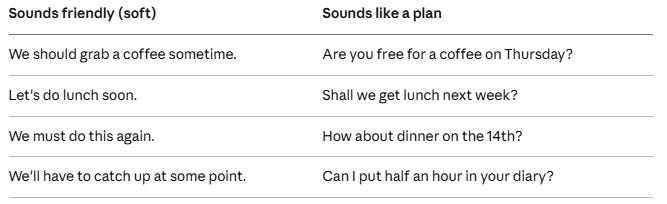
Notice the pattern on the left. The soft ones use “should”, “must”, and “we’ll have to”, and they end with a vague word like “sometime”, “soon”, or “at some point”. They describe a nice idea without asking you to do anything.
The ones on the right either ask you a question or name a day. That’s the giveaway.
TWO → Is there a next step? A real plan usually comes with an action attached. “I’ll send you a couple of dates.” “I’ll drop you an email.” “Let me check my diary and get back to you.” If you hear one of those, someone is actually going to make it happen.
THREE → Who’s going to follow up? With a real invitation, one of you will send a message. With a friendly one, often nobody does, and that’s fine. Nothing has gone wrong.
What to say back

If the invitation is soft and you’re happy to leave it there, you don’t need to pin it down. Just warm it back:
“Yes, I’d like that.”
“Definitely. It was good to see you too.”
That’s a complete, polite answer. You’re matching their warmth without turning it into homework for either of you.
But what if you actually want that coffee to happen? Then you turn the soft invitation into a real one. You do this gently, by adding what it was missing: a time, or a question.
Them: “We should grab a coffee sometime.”
You: “I’d love that, actually. Are you free at all next week?”
You’ve taken their friendly line and given it a specific next step. Most people respond well to this, because you’ve done the slightly awkward part for them.
Making your own invitation sound real
Now the other side. Sometimes you genuinely want to meet someone, you say “we should get lunch”, and then it never happens, and you can’t work out why. Usually it’s because you issued a friendly invitation by accident, and they read it exactly as one.
If you mean it, three things make an invitation sound like a plan:
Name a time, or ask for one. “Are you free for lunch on Wednesday?” beats “we should get lunch” every time.
Offer a concrete next step, such as “I’ll send you a few dates”. That tells the other person this is really going to happen.
Put it in writing. A short follow-up message the same day is what turns a nice moment into an actual meeting.
Compare these two:
Soft: “We should definitely catch up properly soon.”
Real: “I’d really like to catch up properly. Are you around for a coffee next Thursday or Friday? I’ll send an invite.”
Same warmth. One of them will happen.
The phrase itself is rarely what decides things. Whether a coffee ever happens comes down to one small act: someone names a day and sends the message. If you want it to happen, be the person who does that.
Come and join us. Your more confident English self is closer than you think.