



Many English learners believe that mistakes are signs of failure.
You might find yourself waiting to speak until you have the “perfect” sentence ready in your mind. You check your grammar, your word choice, and your pronunciation before saying a single word. By the time you are ready, the conversation has moved on.
This is the perfectionism trap.
Perfectionism feels like a safety net, but it is actually a cage.
When you focus only on being 100% correct, your brain stays in “analysis mode” instead of “communication mode.” This fear of making a mistake creates stress, which makes it even harder to remember the words you already know.
To reach fluency, you must realise that communication is about connection, not a perfect score on a test. If you wait until you are perfect to speak, you may never speak at all.
The Power of the Essentials
Fluency is not about the size of your vocabulary; it is about the speed of your delivery.
By focusing on a “core” set of tools, you can handle the vast majority of daily conversations without the stress of searching for rare words.
1. The Word Swap
Replace academic words with high-frequency verbs to reduce “thinking time.”
Buy / Get (Instead of Purchase or Acquire) — Faster to say and fits any context.
Start (Instead of Commence) — Standard in both business and casual talk.
See / Watch (Instead of Observe) — Feels more natural and less formal.
Ask (Instead of Inquire) — Reduces the time spent on complex grammar.
Stop / End (Instead of Terminate) — Clearer and harder to misunderstand.
2. Natural Connectors
Avoid “stiff” textbook transitions to keep your speech flowing.
Also / And (Instead of Furthermore) — Use for adding information quickly.
So (Instead of Consequently) — Use for showing a result without a long pause.
But (Instead of Nevertheless) — Use for showing a contrast clearly.
Plus (Instead of In addition) — Use for keeping the rhythm of the conversation moving.
3. Strategic Filler Words
Use “mental bridges” to hold your place while you think. This prevents the “frozen” silence that causes anxiety.
“Well...”: Gives you two seconds to start an answer.
“Actually...”: Use this when adding a fact or correcting a point.
“I mean...”: Helps you clarify a point if you feel you were unclear.
4. The “LEGO Blocks” (Collocations)
Instead of building sentences word-by-word, use pre-made blocks.
Make: Make a mistake / Make a decision.
Do: Do your best / Do a favour.
Take: Take a break / Take a photo.
Have: Have a look / Have a coffee.
The Power of “Good Enough”
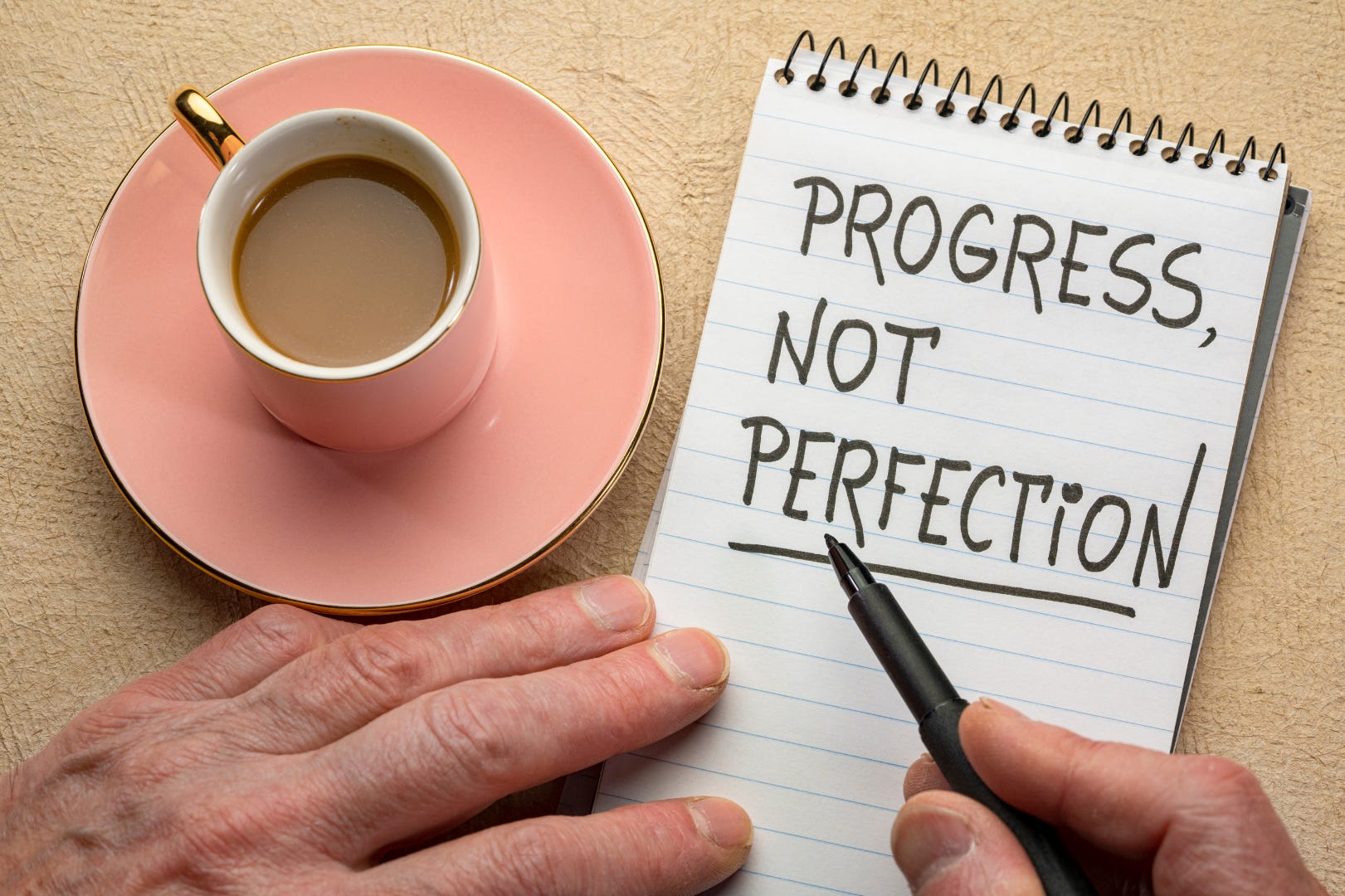
In a classroom, you are often graded on your mistakes.
In the real world, you are graded on your results.
If you go into a café and order a coffee, and the barista hands you a coffee, you have succeeded.
Shifting your goal from total accuracy to successful connection changes how your brain works. When you aim for connection, you are in “active mode.”
Most native speakers are not grammar police; they will mentally fix your small mistakes because they want to understand you.
Think of your English like a bridge. It doesn’t need to be made of gold to work; it just needs to be strong enough to get you to the other side.
The Messy First Draft
To reach fluency, you must learn to write and speak without a safety net.
Practice “The Messy First Draft.” Set a timer for five minutes, choose a topic, and do not stop writing.
Do not use a dictionary!
If you forget a word, describe it using simpler terms. Your goal is not to produce a masterpiece; your goal is to get your thoughts onto the paper. This trains your brain to prioritise the message over the mechanics and proves you have the tools to communicate right now.
Vulnerability as a Tool
Making mistakes is necessary for your brain to grow.
Every time you stumble and realise it, your brain creates a new, stronger connection. Progress requires the “friction” of making mistakes.
Treat every mistake as valuable data. An error is a map that tells you where your current limit is. When you speak English with errors, you are practising bravery.
Real fluency requires you to be willing to sound “wrong” today so you can sound “right” tomorrow.
Confidence only comes after you take the risk.
Actionable Fluency Tips
Use this daily checklist to prioritise speed over perfection:
Narrate Your Life: Spend 2 minutes describing your actions out loud.
The Shadowing Hack: Listen to 30 seconds of a podcast and repeat it immediately. Focus on rhythm.
Voice Memo Audit: Record yourself for 1 minute, listen once, then delete it.
The “Context” Rule: Read for 10 minutes without a dictionary. Guess meanings from the situation.
The Big Takeaway: Fluency is not a reward for being perfect; it is the result of being willing to be messy. Prioritise connection over correction to bypass the anxiety that keeps you silent.
Share your first “Messy Draft” paragraph in the comments below - no dictionaries allowed! Or, join our monthly “Mistake-Friendly” Conversation Class and Grammar Drop-In Session to practice!
Monthly Classes

Whether you want to practice speaking or get help with a tricky grammar point, we have two distinct ways for you to join our community.