

You can pass every grammar test, spell “necessary” correctly under pressure, and still walk away from a conversation with absolutely no idea what just happened.
That’s not a failure of your English. It’s a feature.
A huge part of English, especially the British kind, happens in the space between the words. What people say and what they mean are often two different things, and nobody hands you the key.
This is the part they don’t put in the textbook, so let’s put it here instead.
Rule one: we very rarely say what we mean

The single most useful thing to understand about British communication is understatement. We turn the volume down on everything. Something wonderful is “not bad”. Something terrible is “a bit of a shame”. A total disaster is “less than ideal”.
This gets confusing at work, because the polite version and the honest version use the same words. Here’s a rough translation guide for the phrases that catch people out.
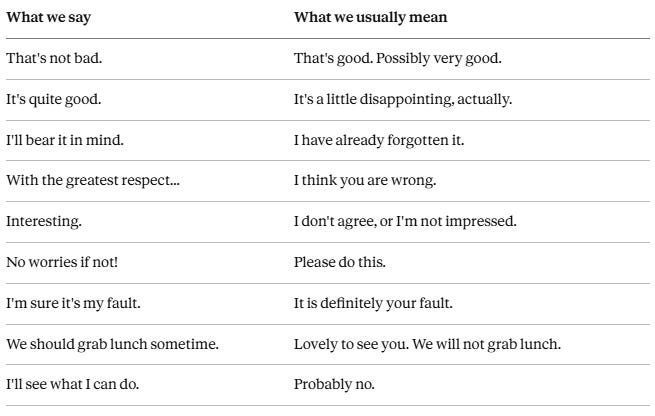
None of this is lying. It’s cushioning. We soften bad news and shrink good news, all so nobody feels awkward. The skill you need is reading the gap: when a British colleague is very polite and very vague at the same time, that vagueness is usually carrying the real message.
A quick test. If someone says your proposal is “interesting” and then changes the subject, they did not find it interesting. Sorry!
Rule two: the jokes are a good sign

British workplaces run on humour, and it can throw you completely if you’re not expecting it. Three things are worth knowing.
We put ourselves down. A British colleague will happily say “well, I made a complete mess of that” about their own work. This is not low confidence. It’s a social move. Making yourself the target first is seen as friendly and modest, and it invites everyone to relax. If you can do a little of it too (”my spreadsheet skills are a work in progress”), people warm to you fast.
Teasing means they like you. Gentle mockery, what we call “banter”, is a sign of acceptance, not an attack. If your colleagues start joking about your terrible taste in tea or your habit of arriving four minutes late, you’re in. Being too formal with someone is often the sign that they’re keeping their distance.
We say the opposite of what we mean, with a flat face. This is sarcasm, and the British version is very dry. Someone looks out at pouring rain and says “lovely weather”. The trick is the flat, calm delivery. There’s no wink, no big smile. If a sentence obviously doesn’t match the situation, that’s your clue it’s a joke.
And here’s the reassuring part: you do not have to get every joke instantly. If you’re not sure whether someone is serious, a light “are you joking, or...?” is completely fine and usually gets a laugh of its own. Nobody expects a second-language speaker to catch every bit of sarcasm. They do notice when you take it in good spirit.
One warning. In a first meeting, keep your own jokes small. Humour lands best once people know you a little. Start dry and gentle, and build from there.
Rule three: learn the idioms that actually turn up

English is stuffed with idioms, and most of the ones in old textbooks never appear in real offices (”it’s raining cats and dogs” is not going to come up in your budget review). Here are the business ones you’ll genuinely hear, in plain English.
Touch base = have a quick chat to check progress. “Let’s touch base on Friday.”
Circle back = return to this topic later. “Can we circle back to the numbers?”
A ballpark figure = a rough estimate, not exact. “Just give me a ballpark.”
Put it on the back burner = leave it for now, deal with it later.
Take it offline = discuss it privately, not in this big meeting.
Low-hanging fruit = the easy wins you can get quickly.
Get the ball rolling = start something.
On the same page = we understand and agree with each other.
I’ve got a lot on my plate = I’m very busy.
Run it past someone = ask for their opinion or approval first.
You don’t need to use these to impress anyone. You need to recognise them so you’re never lost when a manager says “let’s park that and circle back”. (Yes, “park” means the same as “back burner”. We have far too many ways of saying “later”.)
Rule four: the small rules that quietly matter

These are the unwritten social habits. Break them and nothing terrible happens, but following them makes you feel like an insider.
“How are you?” is not a question. When a colleague says it in the corridor, they are saying hello. The correct answer is “fine thanks, you?” and you both keep walking. Do not give a real medical update.
Small talk comes first. Before a meeting gets going, there’s usually a minute of nothing important: the weather, the weekend, your journey in. Skipping straight to business can feel a bit cold. Have one small comment ready and you’ll never be caught out.
We apologise for everything. Someone bumps into you, and you say sorry. This is not an admission of guilt. It’s social oil. If you accidentally start apologising for the weather, congratulations, you’ve fully arrived.
“Cheers” is doing a lot of work. It means thank you. It also means goodbye. Sometimes both at once, at the end of an email or a phone call. Context tells you which.
Saying no without saying no. People rarely refuse directly. “I’ll see what I can do”, “that might be tricky”, and “let me check” are often polite nos. Listen for hesitation. If the answer sounds soft and slow, it’s probably not happening.
The word “just” softens everything. “Just checking in”, “just a quick question”, “just wondering if you’d had a chance”. It makes a request feel smaller and more polite. You’ll see it constantly in emails, and it’s a handy tool of your own.
Try this…
❌ Don’t try to memorise all of this.
✅ Do one thing instead: this week, listen for the gap between the words and the meaning.
When someone is being very polite and very vague, ask yourself what they’d say if they were being blunt. When a colleague teases you, take it as a welcome rather than a slight. When your proposal gets called “interesting”, assume you have work to do.
Your grammar was never the problem. The room was just speaking a second language on top of the first one, and now you can hear it.
Come and join us. Your more confident English self is closer than you think.