


Two people are standing at the same desk at the airport, with the same problem. One of them says:
“My suitcase didn’t arrive.”
The other one says:
“My suitcase hasn’t arrived.”
Both sentences are correct English. Only one of them sounds like a problem that still needs solving.
What the two tenses actually say
The past simple (”didn’t arrive”) talks about finished time. It tells a story about something that happened and then ended. It is the right tense for telling a friend about your holiday next week.
The present perfect (”hasn’t arrived”) talks about now. The action happened in the past, but the result is here, in front of you, and somebody needs to do something about it.
That is why the present perfect is the tense of complaints, problems, and lost property. You are not telling a story. You are describing a situation.
❌ Not: “The air conditioning stopped working.”
✅ Better: “The air conditioning has stopped working.”
❌ Not: “I lost my ticket.”
✅ Better: “I’ve lost my ticket.”
❌ Not: “You charged me twice.”
✅ Better: “You’ve charged me twice.”
The first sentence in each pair is not a mistake. It just puts the problem in the past, and the person listening can hear that difference.
The form
Have or has, plus the third form of the verb.
I / you / we / they have lost the tickets.
He / she / it has lost the tickets.
In speech you will almost always hear the short form: I’ve, you’ve, he’s, she’s, it’s, we’ve, they’ve.
Most of the verbs you need for travel problems are irregular, so learn these as a set:
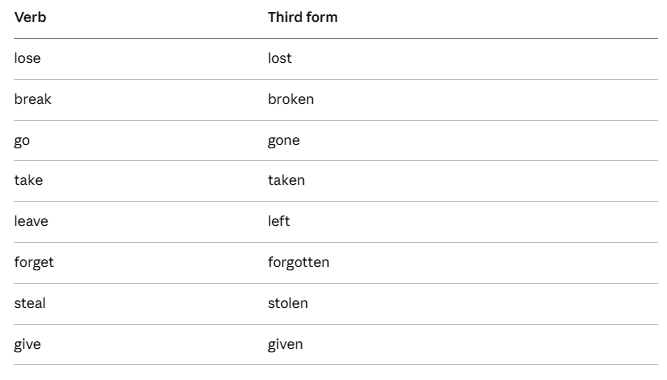
“Someone has taken my seat.”
“I’ve left my phone in the taxi.”
“My wallet has been stolen.”
That is the tense. What follows is the part you actually say out loud: the sentences for cancelled flights and double charges, the four small words that turn a polite sentence into a request somebody acts on, and the one mistake that makes the whole thing collapse.
