

🔧Welcome to the Friday Fix!
👉 Each Friday, we break down a real-world professional problem and replace “textbook” phrases with the authentic, native-level language that actually gets results.
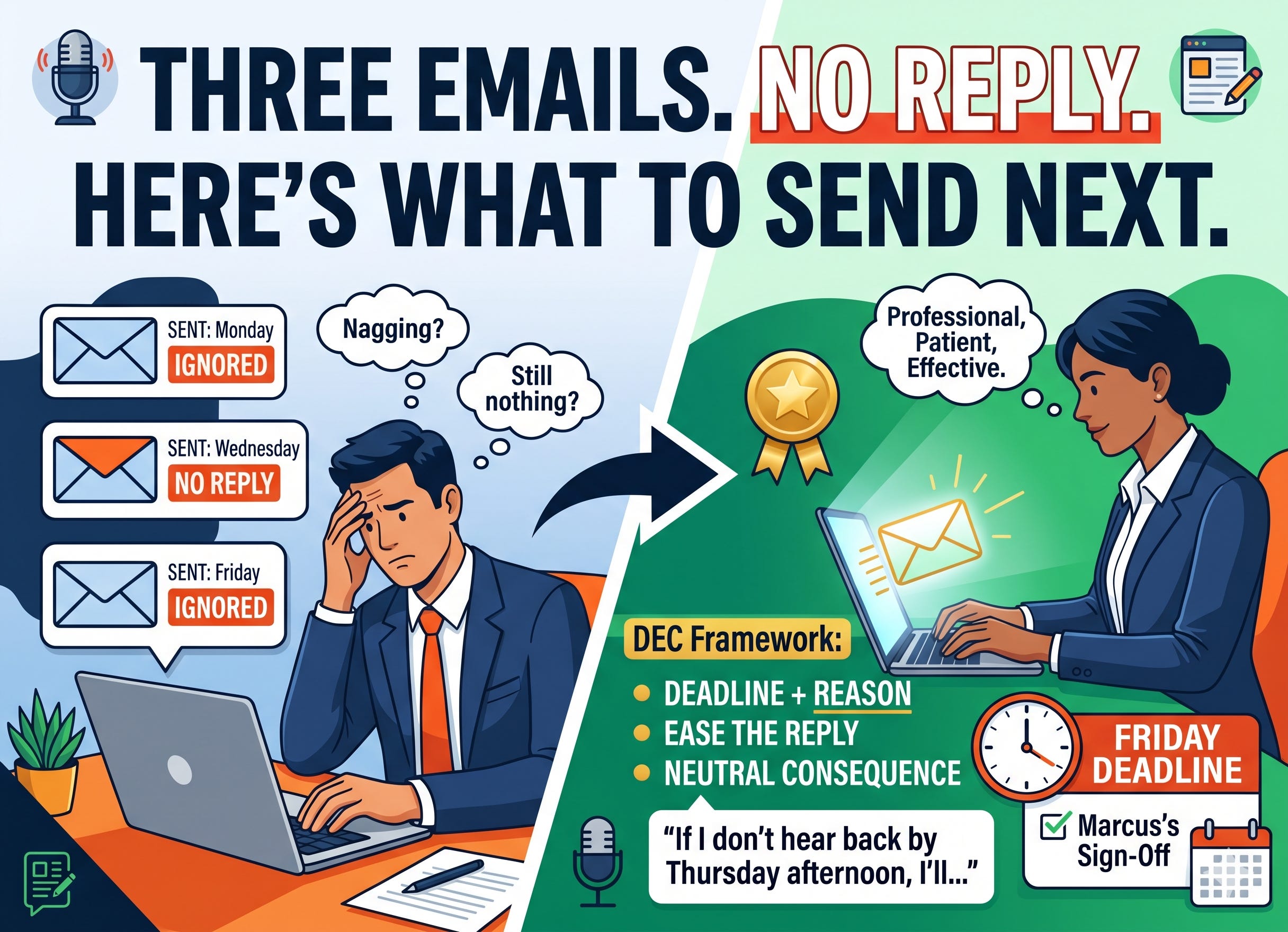
You sent the first email on Monday. Polite. Professional. Clear.
You followed up on Wednesday. A short note. Friendly tone. Nothing.
You followed up again on Friday. Still nothing.
Now it is Tuesday. You need an answer before your team can move forward. And you are asking yourself: do I send another email? What do I even say? How do I do this without sounding like I am nagging?
The Situation
You are the project coordinator on a product launch. Before your team can confirm the schedule with the client, you need sign-off from Marcus, a senior colleague in the legal department. He is busy. You know that. But you have sent three emails over ten days and heard nothing.
Your deadline is Friday. If you do not have Marcus’s sign-off by then, the client call gets pushed back by two weeks.
You need to send one more email. And this one has to work.
The Challenge
Write a follow-up email to Marcus (4-5 sentences) that:
• Names the deadline and explains why it matters -- give him a reason, not just pressure
• Makes it easy to say yes quickly -- reduce the effort required
• Offers a polite default -- what happens if he does not respond
• Keeps the tone completely neutral -- no frustration, no guilt
Have a go before scrolling down.
Phrases you’ll need for this one:
• “I wanted to check in one more time on...”
• “We’re up against a deadline of [date] because...”
• “If it’s easier, I’m happy to...”
• “If I don’t hear back by [date], I’ll...”
👇 Ready to see how a professional handles this? The model answer, the breakdown of why each phrase works, and the biggest mistake most ESL speakers make when chasing responses are below. 🔒
