A student of mine told me something recently that stuck with me.
She said, "Paul, in my language, I am funny. I am smart. I am the person people come to for advice. In English, I am invisible."
She has a master's degree. She manages a team of twelve. She speaks three languages. And in every meeting at her international company, she sits quietly, waiting for the conversation to move on before she has found the right way to say what she thinks.
Sound familiar?
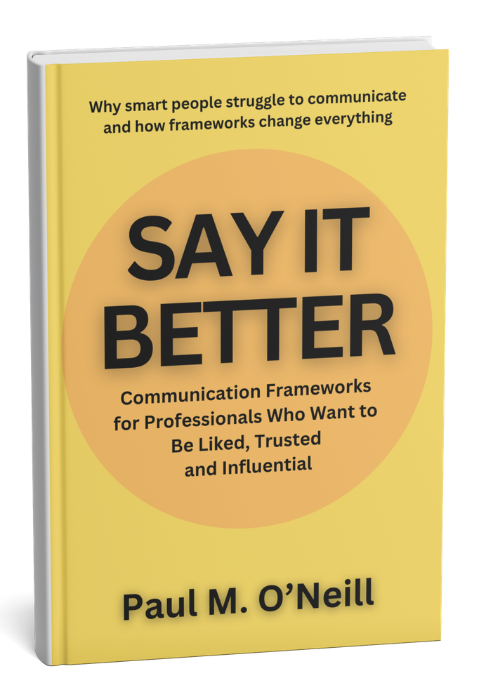
I wrote Say It Better for people like her. And honestly, for people like a lot of us. Because the three things that hold most professionals back when they communicate at work have nothing to do with vocabulary or grammar.
1. Nobody teaches you how to start a conversation that actually goes somewhere
You walk into a conference, a team dinner, or an onboarding week with new colleagues. You know you should network. You know it matters. But what do you actually say after "Hi, nice to meet you"?
Most people get stuck in a loop of "What do you do?" and "Where are you from?" and then stand there holding a coffee, hoping somebody rescues them.
The book includes frameworks specifically for this. Not scripts. Frameworks. Simple structures that help you move a conversation from polite small talk to something real, where the other person walks away thinking, "I liked talking to them."
That feeling is where professional relationships begin. And most people leave it entirely to chance.
2. Nobody teaches you how to say no without burning a bridge
Your manager asks you to take on another project. Your workload is already at breaking point. You know you should push back. But how?
If you say nothing, you end up overwhelmed and doing everything badly. If you say no too bluntly, you worry about the consequences. So you say yes, and you resent it.
This is one of the hardest communication challenges in any language, and it is ten times harder when you are doing it in your second language with a senior colleague.
Say It Better gives you a clear, four-step structure for these moments. You describe the situation, express your concern, suggest a solution, and explain the benefit. It is direct without being aggressive. It is honest without being rude. And once you have used it once, you realise that saying no properly actually builds more trust than saying yes to everything.
3. Nobody teaches you how to make your ideas land in a meeting
You have been in this meeting before. Six people around the table. Three of them talk constantly. Two sit quietly. And you are somewhere in the middle, waiting for the perfect moment to contribute.
When that moment comes, you have about thirty seconds before someone else jumps in. If your point is not clear, structured, and confident in those thirty seconds, it disappears.
The book shows you how to structure a response so that your point lands immediately. Not a long explanation. Not a slow build-up. You lead with your conclusion, support it, and close. The people who do this well are not more intelligent than you. They are not more senior than you. They have a structure, and you do not. That is the only difference. And it is the easiest thing to fix.
The book is out now
Say It Better covers 14 communication frameworks for professional situations. Conversations. Meetings. Feedback. Presentations. Difficult conversations.
Each one follows the same format: here is the problem, here is the framework, here is how to use it, and here are the mistakes to avoid.
If you have ever walked out of a meeting thinking, "I should have said something," this book is for you.
Pick one framework.
Try it this week.
Tell me how it goes.