


Preparing for an English exam can feel overwhelming, especially when deciding which test to take. Should you go for IELTS, TOEFL, or a Cambridge exam?
Let’s dive into a story that highlights the differences and helps you choose the right one for your goals.
Emma’s Journey: Choosing the Right English Exam
Emma, a marketing professional from Brazil, wanted to study abroad in 2025. She needed to prove her English proficiency to universities but wasn’t sure which exam was best for her. Here’s what she discovered:
IELTS: Perfect for students aiming for English-speaking countries like the UK, Australia, or Canada. Its Speaking test involves a face-to-face interview, which Emma thought would feel more personal. However, it requires a broad range of skills, including academic writing, which was her weak point.
TOEFL: Ideal for applying to U.S. universities. Emma liked that it was entirely online, including the Speaking section, where she recorded her answers. She felt less pressure talking into a microphone but realised it required fast typing and good listening skills to integrate tasks.
Cambridge Exams (e.g., C1 Advanced): Known for their lifetime validity, these are excellent for demonstrating a high level of English. Emma found the Speaking part required discussing topics and collaborating with a partner. She liked the idea but was unsure if she needed a certificate that would last forever since her focus was solely on university admission.
How Emma Prepared for the Speaking Part
Emma realised that the speaking section would be crucial no matter which exam she chose. Improving her speaking skills helped her in all areas, boosting her confidence and fluency.
She practised using real exam prompts, recorded her responses, and got feedback from her teacher. She took a lot of time to prepare for any possible topic.
Top Tips…
1. Understand the Exam Format
Every English exam has a unique structure. Familiarise yourself with the sections, timing, and scoring criteria. For example:
IELTS includes Listening, Reading, Writing, and Speaking. For more information check HERE.
TOEFL is taken online and includes integrated tasks combining skills. For more information check HERE.
Cambridge Exams offer varying levels, from B1 Preliminary to C2 Proficiency. For more information check HERE.
Knowing what to expect helps you focus your study time effectively.
2. Practice Your Weak Areas
Take a practice test early in your preparation to identify where you need improvement. If your writing scores are lower, focus on:
Expanding your vocabulary for formal and academic contexts.
Improving grammar to avoid common mistakes.
Practising under timed conditions to mimic exam pressure.
For speaking, find a language partner or teacher to help improve your fluency and pronunciation.
3. Use Quality Study Materials
Invest in reliable resources tailored to your exam. Choose official preparation guides, sample tests, and targeted exercises for grammar, vocabulary, and skills practice.
Remember, consistency is key. Plan a realistic study schedule and stick to it. Even 30 minutes a day adds up over time.
Enhance Your Speaking Results with our Speaking Exam Preparation Notebook!
If you’re looking to boost your performance in the speaking section of your English exam, check out my Speaking Exam Preparation Notebook, available on Amazon.
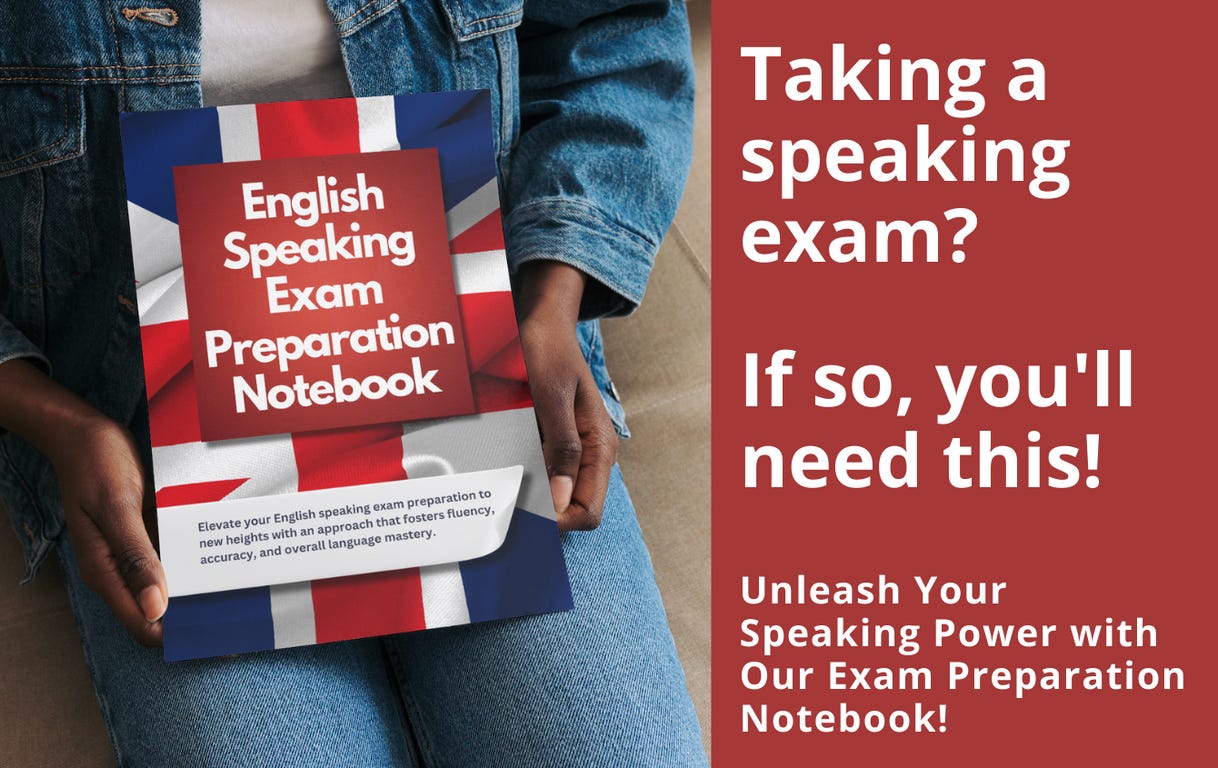
This notebook is the place to collect all your language speaking exam needs, from vocabulary and grammar to key phrases and expressions, plus notable stories you could tell.
Amplify your vocabulary: Gather and enhance your vocabulary with essential words and phrases relevant to key topics and themes so you're never at a loss for words.
Master conversational skills: Add important conversational phrases and expressions that will make your speech natural and engaging, keeping the examiners hooked.
Develop storytelling prowess: Prepare anecdotes and personal experiences that will add depth and authenticity to your spoken responses, making your answers truly memorable.
Start building your confidence today!
Extra Advice

1. Manage Your Time Wisely
Time management is crucial in any exam. Each section is timed, so practice pacing yourself during your preparation.
In reading, don’t spend too long on one difficult passage—move on and come back if time allows.
For writing tasks, allocate time for planning, writing, and reviewing.
In the speaking section, listen carefully to the question and stay on topic—rambling can waste precious seconds.
Tip: Use a timer during practice to build a sense of how long tasks should take.
2. Learn Exam-Specific Vocabulary
Every English exam has common themes, such as education, environment, technology, or travel. Build a strong vocabulary related to these topics.
Create word lists for each theme and practice using them in sentences.
Focus on collocations (words that go naturally together) and phrases commonly used in academic or conversational English.
Tip: Vocabulary is especially important for speaking and writing sections, where clear expression can boost your score.
3. Practice Under Real Exam Conditions
Simulate the exam environment during practice sessions to get used to the pressure.
Take full-length practice tests in a quiet space with no interruptions.
For speaking, record yourself responding to prompts in the allotted time.
For listening, use headphones and avoid pausing or replaying audio, as you won’t have that option in the real exam.
Tip: Replicating exam conditions helps reduce stress on the actual day because it feels familiar.