

📣 Before we start: This Monday Spark is just the beginning. To stop being a language student and start being a global communicator, you need a strategic daily system. To get the full professional edge, upgrade to become a Member*:
The Full Daily System: Unlock the Tuesday Vocab Lab, Thursday Grammar Boost, and Friday Fix for a consistent immersion habit.
Live Support: Join our Monthly Group Classes and Grammar Drop-ins to fix high-stakes mistakes in real-time.
The Ultimate Bonus: Get a free digital copy of my professionally published workbook, ‘Speak Like a Brit’ (usually sold on Amazon).
👉 Upgrade to a *Paid Subscriber - it’s like a fitness program for your English.


Here is something we notice all the time with intermediate business English learners. You can talk about money beautifully, as long as the conversation is about saving it. Budgets, costs, expenses, overheads, savings, you have all of that.
The moment the conversation turns to growth, investment or opportunity, something tightens. The sentences get shorter. The pauses get longer. You reach for a word, and it is not there.
This is not a vocabulary problem in the way you might think. It is a vocabulary gap, and it has a very specific shape.
Most business English courses teach the language of caution very thoroughly and the language of growth almost not at all. So you end up fluent in one half of the financial conversation and quietly stuck in the other.
The good news is that the gap is smaller than it feels, and you can start closing it today.
Two vocabularies, one conversation

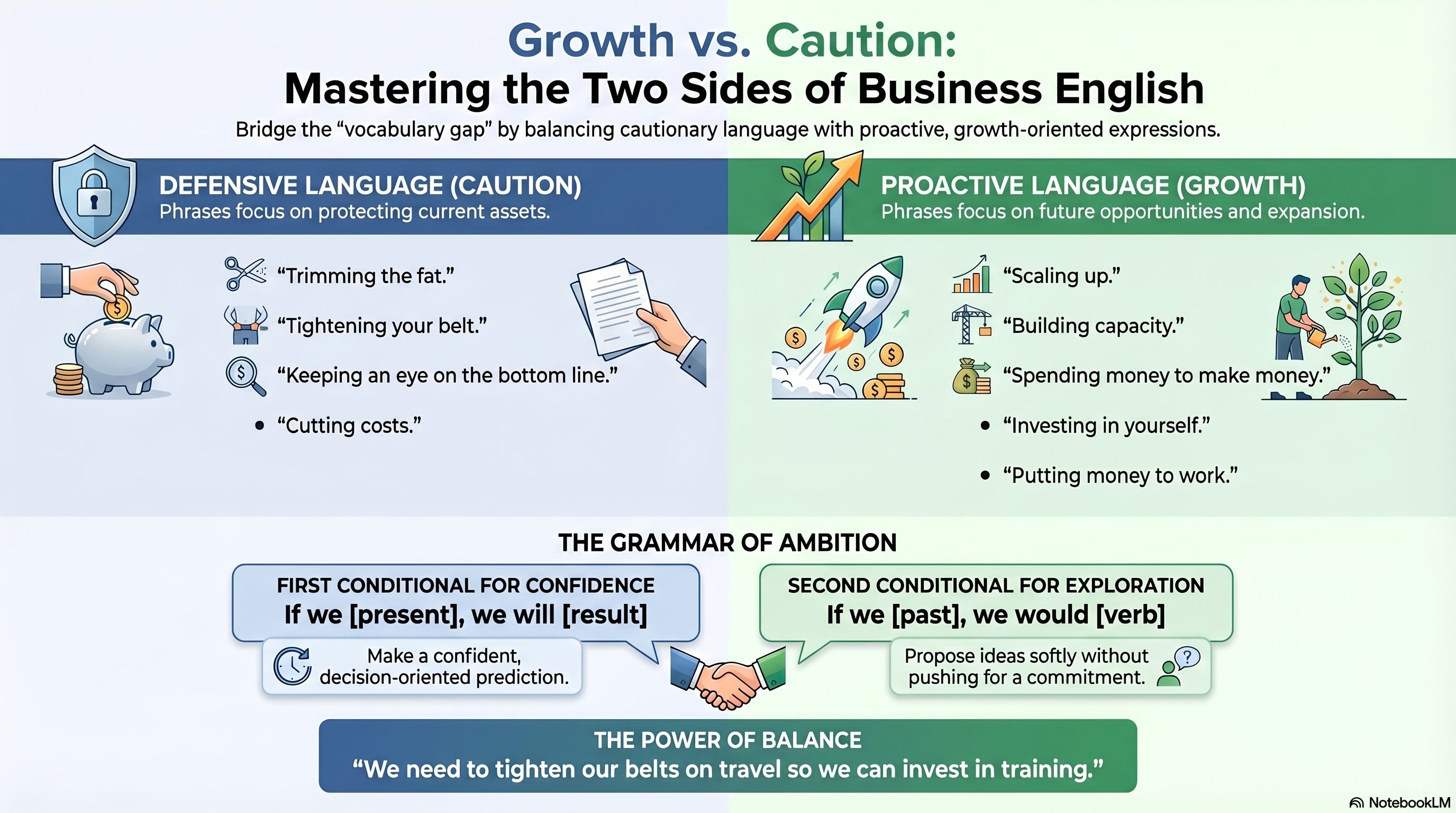
In business English, there is a whole family of expressions for spending less. Cutting costs, tightening your belt, trimming the fat, and keeping an eye on the bottom line. You have probably met all of these. They are useful, and they are everywhere.
There is another family of expressions that gets used just as often by fluent speakers, but far less often in textbooks. Investing in yourself, putting money to work, scaling up, building capacity, spending money to make money. This is the language of growth, and it is the language professionals use when they are talking about the future rather than defending the present.
Notice that these two vocabularies are not opposites.
A confident business English speaker moves between them in the same meeting, sometimes in the same sentence.
We need to tighten our belts on travel so we can invest in training.
That sentence is doing two things at once, and it sounds completely natural because the speaker has both halves of the vocabulary available.
If you only have the cutting-costs half, you can still join the conversation, but you will always sound a little more cautious than you mean to. People will hear you as careful rather than ambitious, even when ambition is exactly what you want to communicate.
The grammar that unlocks it
Here is a small experiment. Imagine someone asks you, “What would you invest in if your company gave you a training budget this year?” Most intermediate learners answer with something like, “I would do a presentation skills course,” or “I would pay for a business English coach.”
Listen to the structure.
If + past simple, would + verb.
That is the second conditional, and it is the grammar of imagined possibility. We use it when something is not real yet but could be. It is the perfect tense for talking about growth, because growth always begins as a hypothesis that someone says out loud.
Compare these two sentences.
If we invest in this software, we will save time. → That is a confident prediction. It almost asks for a decision.
If we invested in this software, we would save time. → That is softer, more exploratory, the kind of sentence you use when you want to put an idea on the table without pushing for a yes.
Both are correct.
Both are useful.
Fluent business English speakers move between them constantly, and the shift is almost invisible until you start listening for it.
Once you do, you will hear it everywhere, in meetings, in pitches, in the careful way good colleagues propose ideas without committing the room.
If you want one small thing to practise this week, this is it. Try saying the same growth idea twice, once in the first conditional and once in the second, and notice how differently they land.
Your takeaways this week
Six expressions worth stealing
to invest in yourself → to spend time, energy or money on your own development
to put money to work → to use money in a way that generates more value
to scale up → to grow a business or activity in a deliberate, structured way
to build capacity → to increase what you or your team can handle
to spend money to make money → to accept that growth requires investment
to keep an eye on the bottom line → to stay aware of profit and loss
One grammar point to notice…
The second conditional (if + past simple, would + verb) is your friend when you want to explore an idea without committing to it. Try writing three sentences this week that begin with If my company invested in... and finish them honestly.
One question to sit with…
Which half of the financial vocabulary do you reach for first, and what would change if you reached for the other?

The Monday Spark is the free taster from English Language Lab.
If you enjoyed this and you would like the full week, Tuesday brings a deeper vocabulary session, Thursday is grammar in context, and Friday is the Friday Fix, a real-world scenario with a worked solution.
Paid subscribers also get monthly group conversation classes
and a copy of the ‘Speak Like a Brit’ book.
Come and join us. Your more confident English self is closer than you think.